
Of course, this year cannot be the same as 2020. From an emotional perspective, belief in BTC is increasing, and from a financial perspective, ETFs will bring in capital inflows in the long run.
Due to the influence of faith and ETF, the bottom of BTC will not be too low, but it cannot be confirmed as the bottom now. From a cyclical perspective, there may be time for further decline or fluctuation.

Macro Aspects
From a macro perspective, this is very much like the second half of 2019. There are two similarities:
The first is interest rates - interest rate hikes have been stopped and interest rate cuts have not yet started.
The second is balance sheet reduction - which is still continuing.
However, please note that there is a very different point. At the end of 2018, it was clearly stated that the balance sheet reduction would stop in the second half of 2019. In other words, the end time of the tightening cycle has been clearly stated. But at present, we do not know when the balance sheet reduction can be stopped.
The Fed’s interest rate decision on February 1 is unlikely to result in a rate cut, but it may reveal some signals, such as when to stop shrinking the balance sheet. In addition, the minutes of the January meeting will be released in February. These two time points may shatter expectations of a rate cut in March. About a month ago, the expected probability of a rate cut in March was 80%, and it is currently 44.3%.
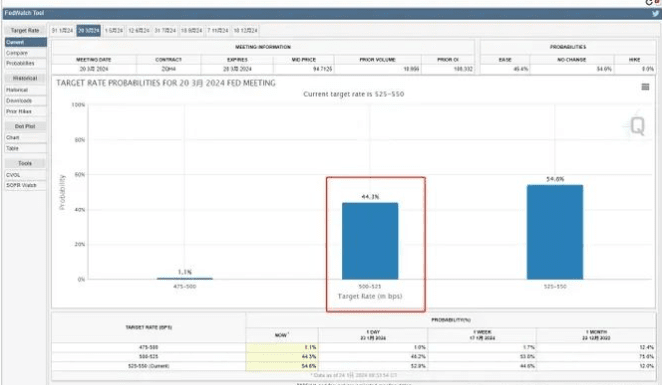
Coupled with the expectation of holiday cash flow during the Spring Festival, the market outlook in February may not be optimistic.
Will the price go up after halving?
Halving is a good thing. I have written about the specific impact of halving in many previous articles, so I will not go into details here.
Halving means that the output is halved. We can start from the perspective of BTC producers, that is, miners. After halving, the income will decrease, and there is a high probability that BTC will usher in a bull market. Therefore, miners are willing to increase mining power and buy more mining machines. The motivation for cashing out before and after halving is likely to be used to purchase new computing power.
But this round is slightly different. The inscriptions increase the miners' income, and the miners' willingness to sell coins may be smaller than before.
What do you think of the current market conditions?
To put it simply, there are two sentences: it won’t go down too low, and it won’t go up too high.
It won't go too low. You should all understand the influence of faith, ETF and inscriptions, so I won't say more.
It will not go up too high, which is mainly affected by the macro environment. In an environment of high interest rates and shrinking balance sheets, market liquidity is limited.
Simply looking at the halving expectations or macroeconomic impacts may be one-sided. The market in 2024 should be the combined impact of the halving cycle and the interest rate cut cycle.
But in the short term: BTC is indeed not expensive now, but the bottom cannot be 100% confirmed in terms of point and cycle.
The macro environment in February (the expectation of a rate cut in March was denied), the cashing out during the Spring Festival, and before the halving, these are all unfavorable factors for the market in February.
Next, we should pay attention to the Federal Reserve meeting in March, because a new dot plot will be released, and there will be further predictions on the specific timing of the interest rate cut.
In February and March, we will focus on the time when the Federal Reserve will stop shrinking its balance sheet, as stopping shrinking its balance sheet means the complete end of tightening.
Will there be another black swan?
One of the black swan predictions is that there is a historical record of crises breaking out in the early stages of rate cuts after a period of high interest rates. The Internet bubble in 2000 and the subprime mortgage crisis in 2008 both broke out in the early stages of rate cuts after a period of high interest rates. The peak of this round of rate hikes is just about the same as in 2006. If the rate is cut in September as shown in the last dot plot, the high interest rate will last for exactly one year, just like in 2007.
However, the scale of this round of balance sheet expansion is really large. Even if the balance sheet is reduced for another 8 months, it will still be at a relatively loose level.
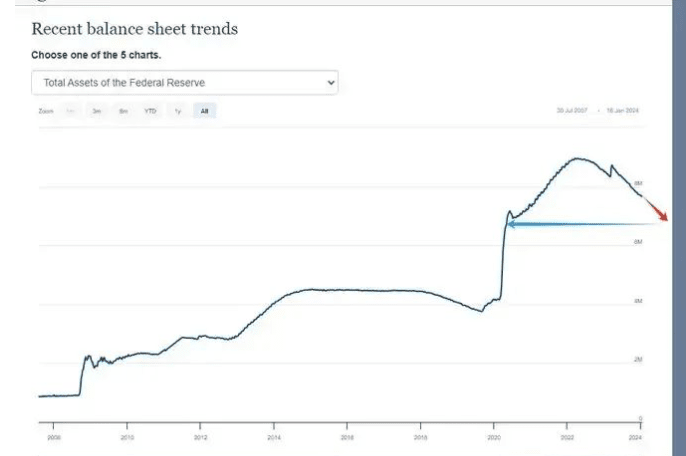
However, there is a high probability that a decline will occur at the beginning of the interest rate cut, which may not be after the interest rate cut, but may be before the interest rate cut. Due to the impact of expectations, the market may react in advance.
In addition, the altcoins are not completely synchronized with the rise and fall of Bitcoin, so it is more rational to build positions in batches.
When to buy the dip
There will be a decline before and after the halving, coupled with the fading expectations of a rate cut in March.
There will be a decline before and after the interest rate cut. Because history shows that when the interest rate is cut, the US stock market tends to fall. (Before the interest rate cut, the expectation is hyped to push up the stock price and then sell it to repay the high-interest loan, and then wait for the interest rate to drop before lending it out.) And this expectation seems to have formed a consensus among some people, so we should be careful when the interest rate is cut and the stock price falls.
However, it is difficult to catch the real bottom, so just buy at the relative bottom. For those who are anxious about missing out, you can buy some positions at 3.8. You can enter the market in batches at 3.5-3.3-3. If it can return to around 30,000, you can buy without thinking.
Set up our strategy in advance. Regardless of whether the market goes up or down, we have corresponding response methods, instead of letting the market determine our thinking. I wish everyone can reap the results they want in this bull market!