

Content | Bruce
Editing & Typesetting | Huan Huan
Design | Daisy
The 'USB-C moment' in the history of AI evolution, in November 2024, the MCP protocol released by Anthropic is triggering an earthquake in Silicon Valley. This open standard, referred to as 'the USB-C of the AI world,' not only reconstructs how large models connect with the physical world but also conceals the code to crack the AI monopoly dilemma and reconstruct the production relationship of digital civilization. While we are still debating the parameter scale of GPT-5, MCP has quietly paved the decentralized path to the AGI era...
Bruce: Recently studying the Model Context Protocol (MCP). This is the second thing that excites me in the AI field after ChatGPT, as it hopes to solve three problems I have pondered for years:
How can non-scientists and geniuses, ordinary people participate in the AI industry and earn income?
What is the win-win combination of AI and Ethereum?
How to achieve AI d/acc? Avoid the monopoly and censorship of centralized large companies, and the AGI destroying humanity?
01. What is MCP?
MCP is an open standard framework that can simplify the integration of LLM with external data sources and tools. If we compare LLM to the Windows operating system, then applications like Cursor are keyboards and hardware, while MCP is like a USB interface, allowing external data and tools to be flexibly plugged in, so users can read and use these external data and tools.
MCP provides three capabilities to extend LLM:
Resources (Knowledge Expansion)
Tools (Execution Functions, Calling External Systems)
Prompts (Pre-written Prompt Templates)
MCP can be developed and hosted by anyone, providing service in the form of a server, which can be taken offline at any time.
02. Why is MCP needed?
Currently, LLM uses as much data as possible for extensive computation and generates a large number of parameters, integrating knowledge into the model to achieve conversational output of relevant knowledge. However, there are several significant issues:
Large amounts of data and computation require a lot of time and hardware, and the knowledge used for training is often outdated.
Large parameter models are difficult to deploy and use on local devices, but in reality, most of the scenarios for users may not require all the information to meet their needs.
Some models use crawlers to read external information for computation to achieve timeliness, but due to the limitations of crawlers and the quality of external data, they may produce more misleading content.
As AI has not brought significant benefits to creators, many websites and content have begun to implement anti-AI measures, generating large amounts of garbage information, which will lead to a gradual decline in the quality of LLM.
LLM finds it difficult to expand to various external functions and operations, such as accurately calling GitHub APIs to perform certain operations; it will generate code according to possibly outdated documentation but cannot ensure precise execution.
03. The architectural evolution of fat LLM and slim LLM + MCP
We can view the current ultra-large-scale models as fat LLMs, and their architecture can be represented by the following simple diagram:
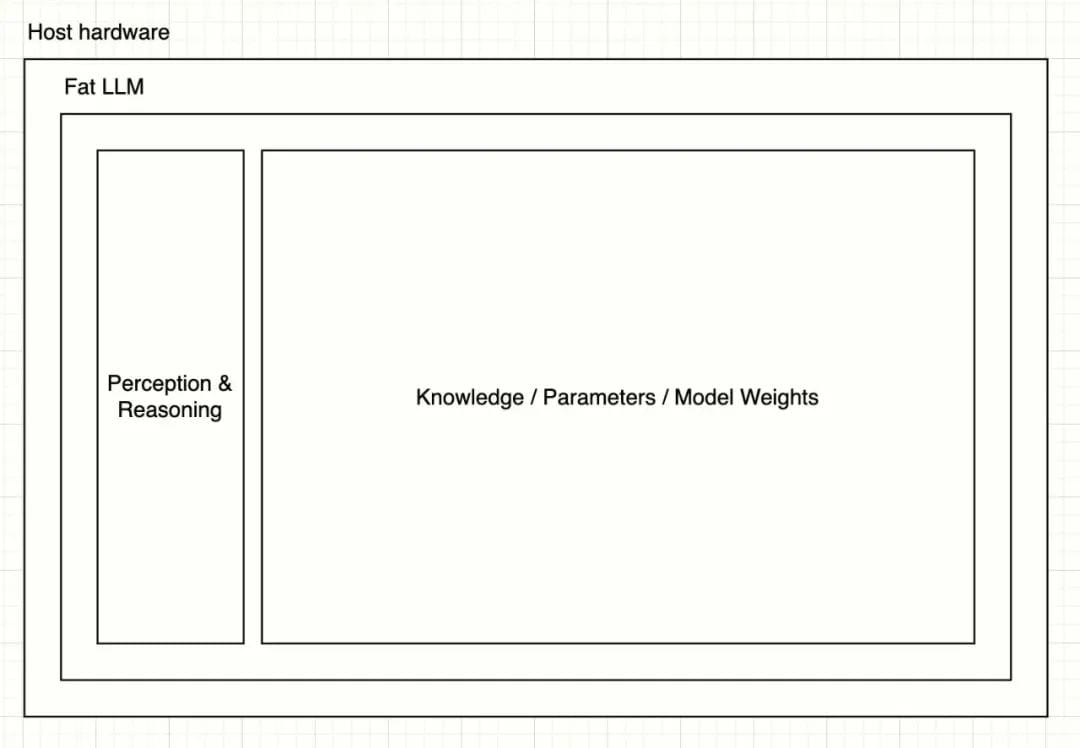
After the user inputs information, the Perception & Reasoning layer breaks down and infers the input, then calls a large number of parameters for result generation.
After being based on MCP, LLM may focus on language parsing itself, stripping away knowledge and capabilities to become slim LLM:
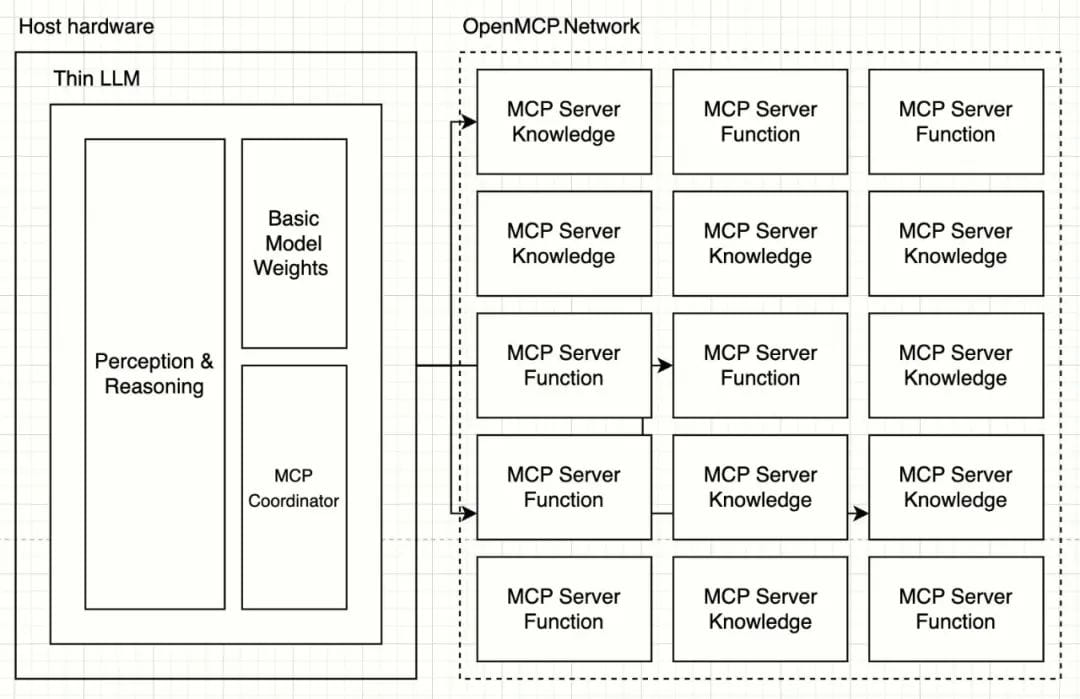
Under the architecture of slim LLM, the Perception & Reasoning layer will focus on how to parse comprehensive human physical environmental information into tokens, including but not limited to: voice, tone, smell, images, text, gravity, temperature, etc., and then orchestrate and coordinate hundreds of MCP Servers through the MCP Coordinator to complete tasks. The training cost and speed of slim LLM will increase dramatically, and the requirements for deployment devices will become very low.
04. How does MCP solve the three major problems?
How can ordinary people participate in the AI industry?
Anyone with unique talents can create their own MCP Server to provide services to LLM. For example, a bird enthusiast can offer their years of bird notes through MCP. When someone uses LLM to search for bird-related information, the current bird notes MCP service will be called. Creators will also earn revenue sharing from this.
This is a more precise and automated creator economy loop, with more standardized service content, and the number of calls and output tokens can be accurately counted. LLM providers can even simultaneously call multiple bird notes MCP Servers for users to choose and rate to determine which quality is better and obtain higher matching weights.
The win-win combination of AI and Ethereum
a. We can build an OpenMCP.Network creator incentive network based on Ethereum. MCP Servers need to host and provide stable services, users pay LLM providers, and LLM providers will distribute actual incentives through the network to the called MCP Servers to maintain the sustainability and stability of the entire network, encouraging MCP creators to continuously create and provide high-quality content. This network will require the use of smart contracts to achieve automation, transparency, trustworthiness, and resistance to censorship. Signature, permission verification, and privacy protection during operation can be achieved using Ethereum wallets, ZK technologies, etc.
b. Develop MCP Servers related to operations on the Ethereum chain, such as AA wallet calling services, allowing users to support wallet payments in LLM through language without exposing related private keys and permissions to LLM.
c. There will also be various developer tools to further simplify Ethereum smart contract development and code generation.
Achieving AI decentralization
a. MCP Servers decentralize AI's knowledge and capabilities; anyone can create and host MCP Servers, and after registering on platforms like OpenMCP.Network, they can receive incentives based on calls. No company can control all MCP Servers. If an LLM provider offers unfair incentives to MCP Servers, creators will support blocking that company, and users will switch to other LLM providers for fairer competition after receiving subpar results.
b. Creators can implement fine-grained permission controls for their MCP Servers to protect privacy and copyright. Slim LLM providers should provide reasonable incentives to encourage creators to contribute high-quality MCP Servers.
c. The capability gap of slim LLM will gradually narrow, as human language has a traversal limit and evolves slowly. LLM providers will need to focus their attention and funding on high-quality MCP Servers rather than reusing more GPUs for mining.
d. The capabilities of AGI will be decentralized and devalued; LLM will only serve as language processing and user interaction, with specific capabilities distributed among various MCP Servers. AGI will not pose a threat to humanity, as after shutting down MCP Servers, it can only perform basic language conversations.
05. Overall Review
The architectural evolution of LLM + MCP Servers essentially decentralizes AI capabilities, reducing the risk of AGI destroying humanity.
The usage of LLM allows for token-level statistics and automation of calls to MCP Servers, laying the foundation for the AI creator economy system.
A good economic system can drive creators to proactively contribute to high-quality MCP Servers, thereby promoting the development of all humanity and achieving a positive feedback loop. Creators will no longer resist AI, and AI will provide more jobs and income, reasonably distributing the profits of monopoly commercial companies like OpenAI.
This economic system, combined with its characteristics and the needs of creators, is very suitable for implementation based on Ethereum.
06. Future Outlook: The Next Script Evolution
Protocols like MCP or similar will emerge endlessly, and several large companies will begin to compete for the definition of standards.
MCP Based LLM will emerge, focusing on parsing and processing human language with small models, accompanied by MCP Coordinator connecting to the MCP network. LLM will support automatic discovery and scheduling of MCP Servers without complex manual configuration.
MCP Network service providers will emerge, each with its own economic incentive system, and MCP creators will register and host their own Servers to earn income.
If the economic incentive system of the MCP Network is built using Ethereum based on smart contracts, then the transactions on the Ethereum network will conservatively increase by about 150 times (based on a very conservative estimate of 100 million calls to MCP Servers daily, currently 12 seconds per block including 100 txs).