

By reflecting on history, one can understand the rise and fall; by reflecting on others, one can clarify gains and losses. By reflecting on myself, I hope to illuminate your trading path.
I became a Day Trader at LSE
In 2007, after the Spring Festival, I received an interview invitation from Swift Trade, and I went to Beijing for the interview at the scheduled time.
Rather than say it was an interview, it was more like a test, with many participants. A lady named Jennifer, in her 30s, dressed for the workplace and very beautiful, took out a stack of white paper and had her assistant distribute it to us. Then she told us we would first play a small game, a coin toss game. The paper contained a table; each person started with 10,000 yuan, and in each round, we would toss a coin. Before tossing, each person would write their bet amount in a column. If the coin lands on heads, you win double your bet amount for that round; if it lands on tails, you lose your bet amount for that round. After 18 rounds, we would see who has the most balance.
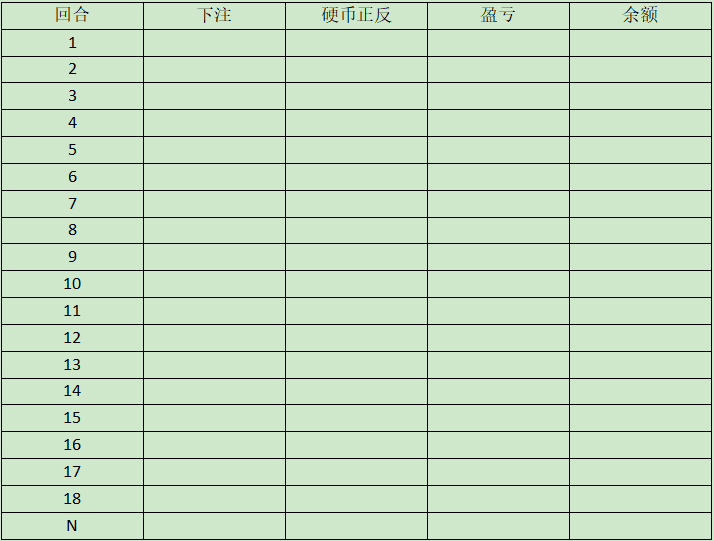
From this game rule, what did everyone see? I saw that as long as you don't lose all your capital in this game, you have a chance to earn it back. Why? Because first, the probability of the coin landing on heads or tails is 50%, there is no advantage in this aspect, but there is also no disadvantage. If you win, you double your bet amount, and if you lose, you lose your bet amount. This way, in terms of the win-loss ratio, it is a favorable rule. Since there are only 18 rounds in total, if luck is against you, all 18 times could land on tails! The only thing I can control is my bet amount.
With the above understanding, I set each bet within a certain percentage of my balance. Before each bet, I set it so that this time would be tails, meaning I would incur a loss. I set my maximum loss limit at 10% of my balance, which means initially I would bet a maximum of 1,000. If I win, my balance would be 12,000, and the next bet would be 1,200. If I lose, my balance would be 9,000, and the next bet amount would be 900. This way, even if tails appears consecutively, I wouldn’t lose everything, and I would still have a chance to recover my losses.
I forgot what the final balance was; that was my first interview. A few days later, they informed me that I passed the first round and scheduled the second round of interviews.
In the second round of interviews, there was Jennifer and a man around 40 years old, whose hair was already thinning, named Frank. I later learned he was our instructor. The two of them asked me a few questions, some of which I don’t remember clearly now, but I faintly recall two questions: First, if in the coin toss game, this time it’s tails, will you continue to bet that it will be tails next time? I said no, because the probability of either side showing up is half and half, and I wouldn’t bet on such probabilities. Second, if the house you bought is next to a very lively dance hall that is noisy every day, would you choose to move? I said it depends; if I am someone who loves noise and dancing, I would feel happy, but if I prefer quiet, I might sell the house. I don’t know if there are correct answers to these questions or what information they wanted to glean from my answers, as they didn't provide any explanations after I finished answering.
There were some other questions later that I don’t quite remember clearly now. The result was that after a while, they told me I had passed the interview and could become their intern trader. The internship period is six months, during which they would provide me with real trading capital. If I meet the standards in any month within six months, I can become a formal trader at Swift Trade.
In March 2007, filled with dreams about the trader profession and a bit confused, I boarded a train heading north.
To be continued.