

On October 9, Robin Linus, co-founder of blockchain developer ZeroSync, unveiled the white paper for BitVM. “Any computable function can be verified on Bitcoin,” Linus said in a post on X (formerly Twitter). “This makes smart contracts on Bitcoin more expressive. In particular, it enables features that we thought would require a soft fork to be possible” — potentially bringing more DeFi use cases and scalability to the network.
BitVM means that Bitcoin can now be Turing-complete like any other chain: allowing developers to run complex contracts on Bitcoin without changing the basic rules of Bitcoin. Its emergence allows Bitcoin to compete with smart contract platforms such as Ethereum while still maintaining its security and decentralization, which has caused heated discussions.
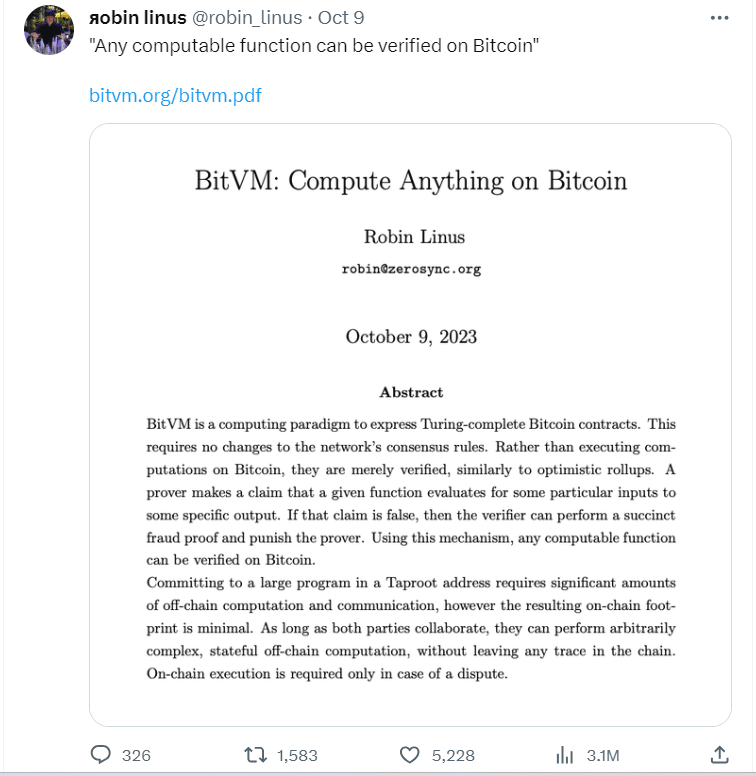 “Any computable function can be verified on Bitcoin” — Robin Linus
Previously, a series of protocols have appeared for the BTC ecosystem, such as the Ordinals protocol created by Bitcoin Core contributor Casey Rodarmor, which gave birth to the first NFT of the Bitcoin network and introduced the concepts of Ordinals and Inscriptions. The Taro protocol, which makes Bitcoin more programmable by introducing a new smart contract language, aims to bring more financial projects to the Bitcoin ecosystem; the RGB protocol, inspired by the concepts of single-use seal and client-side validation proposed by Peter Todd in 2016, also released version v0.10 this year, using Bitcoin as the underlying asset and introducing smart contract functions to Bitcoin.
The emergence of these protocols has brought new possibilities to the development of the Bitcoin ecosystem, not only increasing the functionality and scalability of the Bitcoin network, but also providing community members with more innovative tools to promote the further development of the Bitcoin ecosystem.
What is BitVM?
BitVM is the abbreviation of “Bitcoin Virtual Machine”. We can imagine it as a virtual test lab, in which developers can freely operate any computing program or execute any smart contract, allowing developers to simulate program behavior without imposing any load or changes on the actual Bitcoin network.
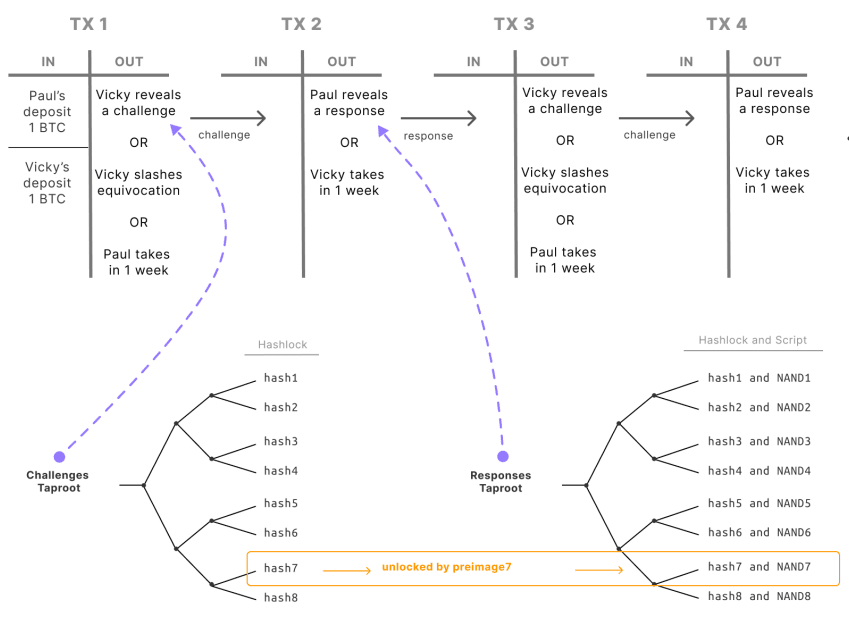 Source: BitVM Whitepaper
By acting as an intermediary, BitVM improves efficiency and reduces the computational burden of the Bitcoin blockchain. Complex computations or smart contracts can be verified off-chain before irreversible operations. Therefore, the system helps maintain the integrity of the blockchain and provides a platform for more complex but secure operations. The roles and workflows in BitVM mainly include:
Participants: The operation of BitVM involves two main participants: the prover and the verifier. The prover is the party that initiates the calculation or statement, and the verifier is responsible for verifying the statement. The dual role cross-verification can achieve a certain degree of checks and balances to ensure that the calculation results are accurate and trustworthy.
Off-chain computing: The ingenuity of BitVM lies in its handling of computing workloads. Unlike traditional blockchain operations that place a large amount of computing burden on the chain, most of BitVM's complex calculations are performed off-chain. Off-chain computing provides higher speed and flexibility, reducing the amount of data stored directly on the chain.
On-chain verification: The only step that BitVM needs to go on-chain is on-chain verification in case of disputes, also known as "fraud proof". If the verifier questions the legitimacy of the prover's statement, the system will refer to the immutable decentralized ledger on the Bitcoin chain to resolve the issue. If the prover's claim is proven to be wrong, the verifier can submit a concise fraud proof to the blockchain, thereby exposing the dishonesty. By integrating off-chain computing and on-chain verification, a balance between computational efficiency and strong security is achieved.
What is the RGB protocol?
RGB is a scalable and confidential Bitcoin and Lightning Network smart contract system developed by the LNP/BP Standards Association, which introduces the complex programmability and flexibility of smart contract platforms such as Ethereum into the Bitcoin ecosystem. It adopts the concepts of private and common ownership, is a Turing-complete, trustless distributed computing form, and does not require the introduction of a non-blockchain decentralized protocol for tokens.
 RGB is designed to run scalable, robust, and private smart contracts on UTXO blockchains (such as Bitcoin), allowing digital assets and smart contracts to bring more functionality to Bitcoin. Through RGB, developers can execute complex multi-category smart contracts such as token issuance, NFT casting, DeFi, DAO, and more, thereby stimulating innovation on top of Bitcoin's powerful blockchain while maintaining its security. Specific execution process:
RGB asset issuance: Allow users to create off-chain contracts to issue RGB assets and assign them to Bitcoin’s UTXO, thereby adding RGB assets to the Lightning Network off-chain payment channel.
Transfers within payment channels: Once added to a payment channel, RGB assets can be transferred and routed between channel participants like Bitcoin Lightning Network payments, and such transfers are completed by client-side verified transfers.
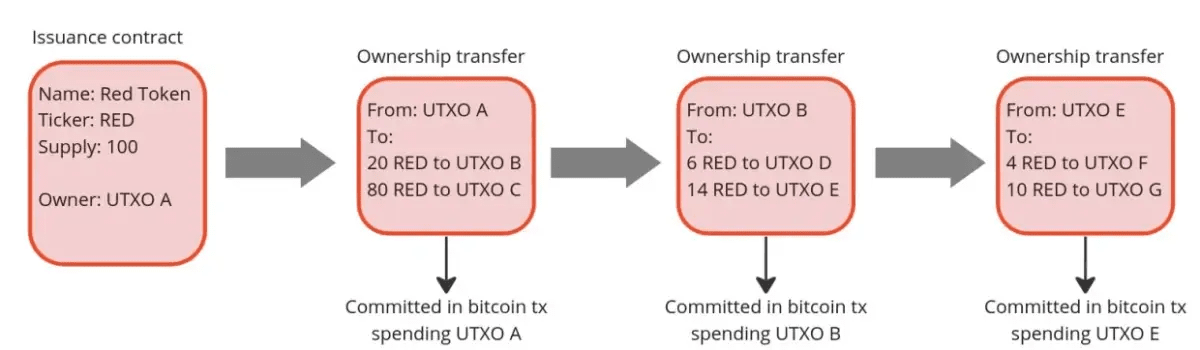 How UTXO model functions
“Fraud Proof”: Every time a channel is updated, assets are sent from the channel multi-signature output to the output created by the Lightning Network Commitment Transaction. This means that if an outdated state of a payment channel is broadcast, it is possible to trigger an RGB penalty transaction, taking away all of the attacker’s RGB assets.
Who is the best solution for the next generation of narrative in the BTC ecosystem?
According to the BitVM white paper, BitVM provides the following “new” features for Bitcoin:
Ability to implement more complex contracts. Traditional Bitcoin contracts are largely limited to basic operations, such as digital signatures and time locks. BitVM opens up a plethora of new possibilities for contract creation. Users can not only create contracts for financial transactions, but also build contracts for more complex decentralized applications (DApps).
The amount of data that needs to be stored directly on the blockchain is reduced. Most of BitVM’s computational work is performed off-chain, which improves the overall efficiency of the network and prevents the blockchain from becoming cluttered with unnecessary data, which can maintain the health and speed of the Bitcoin network.
Strong fraud protection measures ensure the integrity of transactions. BitVM uses a fraud proof system and a challenge response protocol to guarantee that all transactions are honest and transparent. If someone attempts to cheat or submit a false claim, the system's validators can quickly capture and expose the dishonest party by submitting concise fraud proofs to the blockchain.
But in fact, BitVM has unavoidable limitations
The first limitation is that its design focuses on the "two-party setting" of provers and verifiers, which means that the system is not currently capable of handling multi-party transactions or contracts, limiting its applicability for more complex interactions between multiple participants. This limitation may hinder BitVM's ability to keep up with emerging needs and expectations.
The second limitation is that the amount of off-chain data storage and computing required far exceeds the capabilities of modern computers. Although off-chain computing can help minimize the impact of BitVM on the blockchain, the huge computational burden makes it impossible to achieve in practice and only theoretically feasible.
Concepts such as connecting multiple bidirectional channels to form a network (similar to Bitcoin’s Lightning Network) have been seen as a way to expand the functionality of the system. We may expect that the RGB protocol, which is given “high expectations”, can achieve targeted breakthroughs in the limitations of BitVM in the future.
Comparison between BitVM and RGB
Both BitVM and RGB protocols are committed to expanding the functionality of Bitcoin, but they have some key differences in design. BitVM emphasizes off-chain computing and fraud protection to ensure the integrity of contract execution and transactions, while RGB focuses more on privacy.
The client verification mode adopted in RGB's design means that when user A sends assets to user B, user A will not publicly trade on the network, but will send the assets to user B through peer-to-peer transmission. Such a design only needs to use the public network to prevent double payment.
BTC nativeness: BitVM requires protocol changes to Bitcoin, while RGB can be implemented with a soft fork
Complete privacy protection: The RGB protocol means that third parties cannot track the history of RGB assets on the blockchain. Only when user B receives the assets will they know the history of the assets. This is something that BitVM cannot do.
Commercialization: BitVM places extremely high demands on computing power and is only feasible in theory. RGB is better in terms of commercialization.
 Comparision between BitVm and RGB
In summary, the BitVM concept is full of innovation and inspires imagination. However, based on the current implementation of its technical framework, it is clear that it is likely to be limited to the concept stage of the white paper in the short term, and the exploration of long-term application scenarios and practical applications still face huge challenges. In comparison, the RGB protocol has shown a trend of small steps and fast running in large-scale commercial applications, as well as its more mature characteristics. It remains to be seen whether the two can become the next-generation narrative outbreak point of the Bitcoin ecosystem. There may also be other protocols that emerge. Let us wait and see.

