

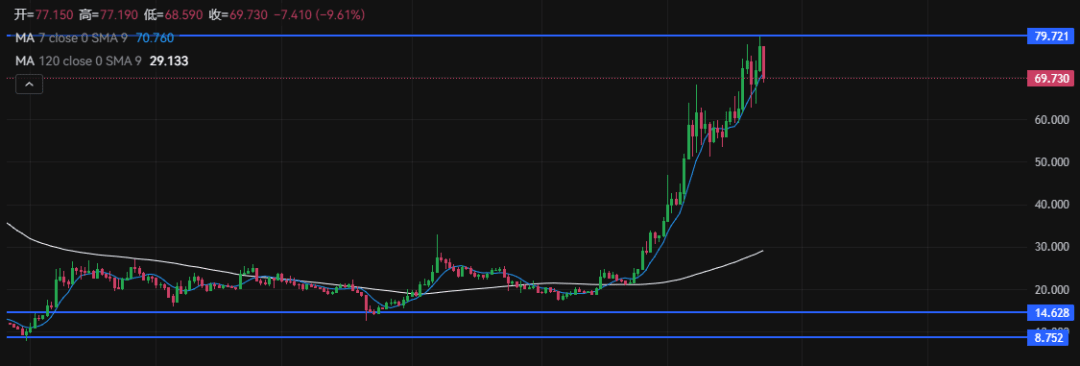
Last week, the wealth effect brought by the airdrop of JTO, a liquid staking protocol within the Solana ecosystem, completely activated the long-ignored on-chain ecological applications. Recently, the price of SOL tokens has been rising steadily. At this time, people have discovered that the Solana ecosystem has recovered strongly, and a number of native new applications are trying to emerge, including the transaction aggregator Jupiter, the liquid staking platform Marinade Finance, and so on.
Other L1 chains have been left behind by Solana.
What makes Solana?
As we all know, Solana was hit hard by the collapse of FTX, and its development was stagnant. As important supporters of Solana and its ecosystem, FTX and Alameda have invested not only in Solana but also in many projects built on Solana. In addition, FTX is the largest holder of SOL, holding more than 71.8 million SOL, accounting for about 13% of the total supply, with a value of nearly US$1.2 billion; and the Solana Foundation also holds millions of dollars worth of FTX shares and FTT tokens.
Therefore, when FTX collapsed, Solana suffered losses in three aspects: first, the size of the treasury assets shrank; second, the funds for ecological applications were drained and a large amount of liquidity outflowed; third, the SOL held by FTX was transferred to the liquidator, and SOL faced market selling pressure.
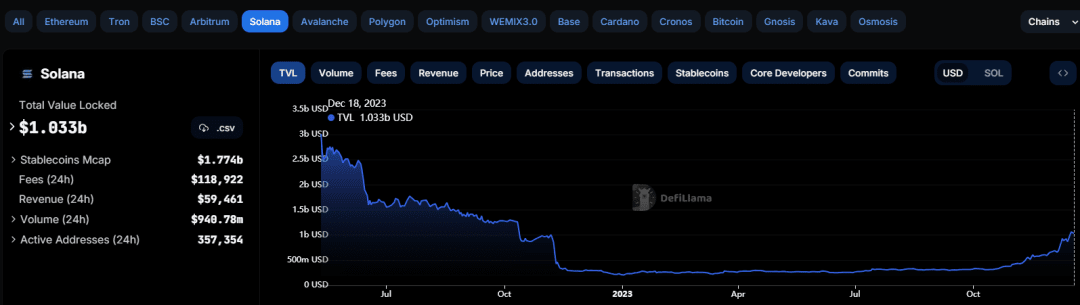
The collapse of FTX has put the Solana network in trouble for a year. The SOL token plummeted to a minimum of around $10, and the price of the coin has been fluctuating around $20 for a long time. The on-chain TVL dropped to around $200 million and has remained in this digital range. During this period, Solana's on-chain applications not only suffered a large outflow of funds, but also a series of hacker attacks, such as the emptying of assets in more than 8,000 Phantom wallets, and the decentralized trading platform Mango suffered a hacker attack, with losses of up to $116 million.
However, with the recent continuous rise in the price of SOL coins and the benefit stories of the airdrops of Solana ecological projects, Solana seems to have recovered.
Since October, Solana ecosystem projects have frequently made public positive moves.
According to ChainCatcher, the oracle project Pyth Network first announced the PYTH token economic model, and then announced that it would airdrop 600 million PYTH tokens to more than 75,000 wallets. On December 5, Pyth developer Pyth Data Association completed strategic financing with participation from Multicoin Capital, Wintermute Ventures and others.
In November, Wormhole, the official cross-chain bridge in the Solana ecosystem, completed a new round of financing of $225 million with a valuation of $2.5 billion, with participation from Coinbase Ventures, Multicoin Capital, Jump Trading, ParaFi and other institutions. Immediately afterwards, Jito, the liquidity pledge protocol of the Solana ecosystem, announced the launch of the governance token JTO, and airdropped 10% (about 100 million) of the total tokens to community users. Subsequently, JTO was rushed to be launched by leading exchanges such as Binance and Coinbase.
The series of actions such as continuous airdrops of ecological application tokens and continuous financial support from well-known crypto capital have completely stimulated the enthusiasm of community users and their loyalty to the Solana ecosystem. Many crypto community users lamented that only on Solana can the poor become rich. Solana ecological applications are very generous to users, rarely fleecing users but giving real airdrop rewards to benefit users.

Solana is an L1 public chain with the following main features: fast transactions, low fees, scalability, and decentralization.
By synchronizing time on the blockchain, Solana ensures consistency between all computers in the network. Unlike Bitcoin and Ethereum. This is also called Proof of History.
By solving the synchronization problem, Solana unlocks the possibility of an extremely fast blockchain limited only by network bandwidth.
While Bitcoin and Ethereum are capped at 15 transactions per second, Solana can achieve over 3,000 TPS with extremely low gas fees.
This enables Solana to build a thriving ecosystem:
DeFi(Marinade、Jito、marginfi)
NFT(STEPN、Mad Lads、Kromes)
Solana Mobile (Saga)
Payments (Sol Pay and Shopify)
Game (Bladerite)
TVL is around $1.06 billion. This is a 5x increase since the beginning of 2023 (TVL was $210 million).
While this is an impressive growth, it’s easy to forget how crazy SOL has been in 2021, with TVL peaking at nearly $10 billion. This means our TVL is still about 10x below ATH (plenty of room to grow). In the past 30 days, SOL has generated an impressive $1.85 million in protocol revenue. Ranked 20th overall and 5th among other public chains. The recent uptrend has been nice, starting in October.
50% of each transaction fee is burned, and the rest is divided among the validators who process the transaction.
Solana is a PoS blockchain with over 2,000 validators. It has an uncapped maximum supply with a unique deflationary release rate. These inflationary releases are rewards to stakers and validators of the network.
The current inflation rate is 6.75% and the staking yield is 6.78%. SOL is the native token used for transaction fees and network security. A large amount of funds are allocated to the team, investors (seed and founding sales), and the foundation.
Current supply statistics:
Circulation: 427.7 million
Total supply: 565 million
Max Supply: Infinity
Market value: $31.2 billion
FDV: $41.2 billion
Market value/FDV: 0.76
The Treasury consists of tokens allocated by the Foundation and represents 10.46% of the total token supply, valued at $4.14 billion.
Additionally, the Solana Foundation Grants Program funds initiatives to decentralize, grow, and secure the network.
In August, a proposal was made to establish Solana governance. Previously, changes were discussed with the community, but Solana Labs had the ultimate responsibility/authority. The first governance vote, “Who should vote in the Solana Governance DAO”, took place in October. The concept of Solana was proposed by Anatoly Yakovenko @aeyakovenko in 2017. The project was then officially launched in March 2020.
Solana has raised a total of $374M in funding over 4 rounds. It remains one of the most VC/investor-backed crypto projects. Solana competes not only with other layer 1 blockchains, but also with layer 2 solutions like Arbitrum, Optimism, and Polygon. In this competitive market, Solana is emerging as one of the frontrunners, building a strong NFT and dApp ecosystem.
The Solana mainnet beta has been running for nearly 4 years, has been audited, and has evolved into a mature blockchain.
Despite an 18-hour network outage in February 2023, Solana has achieved 100% uptime since then. The project also runs a sizable bug bounty program. The Solana mainnet beta has been running for nearly 4 years, has been audited, and has evolved into a mature blockchain. Despite an 18-hour network outage in February 2023, Solana has achieved 100% uptime since then.
The project also runs a sizeable bug bounty program.
In addition, Solana has not stopped in terms of financial support. In April this year, the Solana Foundation introduced a new financing method, Convertible Grants, to support projects in the Solana ecosystem. The mechanism of convertible grants is that these grants will be converted into investments only when the project reaches certain milestones. In May, the Solana Foundation launched a $10 million donation fund to explore ways to combine the Solana blockchain and artificial intelligence.
It can be seen that Solana's ecological strategy is to first strengthen technology, consolidate infrastructure, build industry reputation through excellent data performance, successfully attract the first wave of developers, and then hold online hackathon competitions to discover and reward high-quality projects, attract developers to stay in the ecosystem, and form a positive growth flywheel.
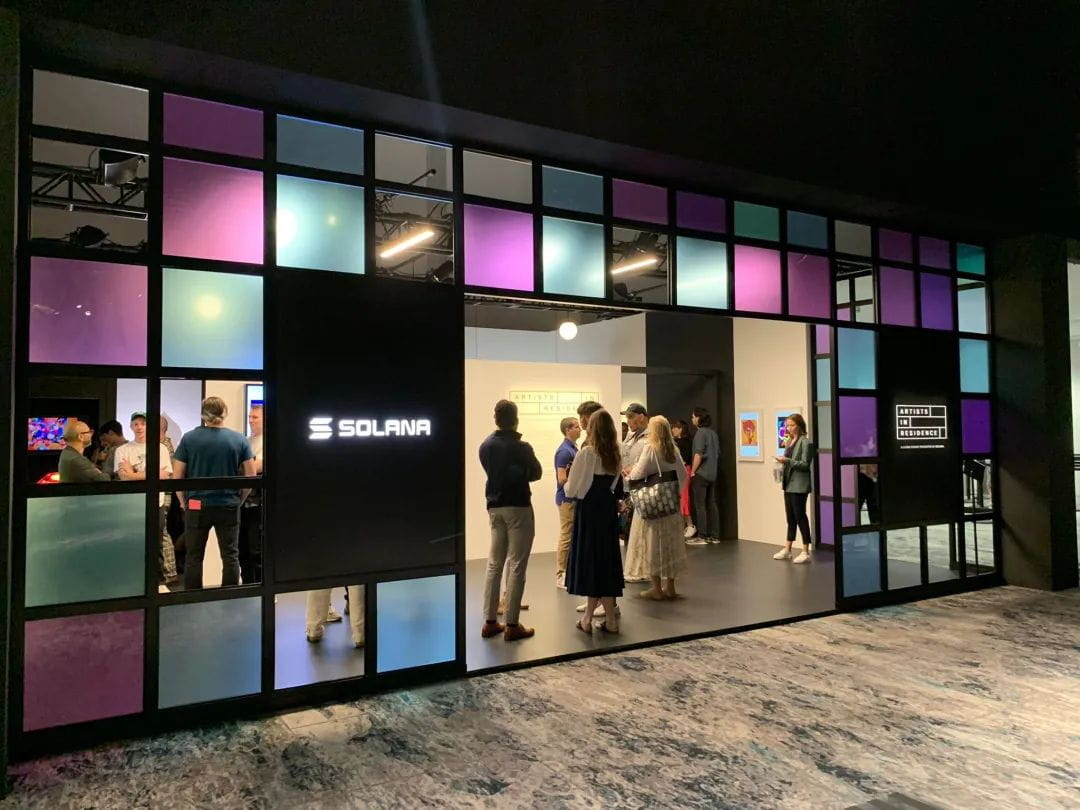
Solana not only supports developers in terms of technology and resources, but also provides an environment for developers to grow and learn. The culture of "new Solana developers 1v1 communication with senior developers" has become an unwritten rule in the Solana community. Solana founder Toly once said in an interview that this is a very good product development process because developers will get a lot of questions or feedback and can make changes immediately. Because we need to know what developers want, what is missing from the documentation, and where developers are stuck. The communication process may change the product roadmap and plan, which is conducive to better building the project.
From this point of view, Solana's ecological strategy is to first strengthen technology, consolidate infrastructure, build industry reputation through excellent data performance, successfully attract developers, and then hold online hackathon competitions to discover and reward high-quality projects, attract developers to stay in the ecosystem, and form a flywheel of positive growth for developers, ecosystem, and users.