

Author: Andrew Singer, Cointelegraph; Translated by: Song Xue, Golden Finance
El Salvador’s controversial $117.5 million Bitcoin investment briefly turned profitable last week for the first time in two years.
It was a milestone because, until now, there had been little progress in cryptocurrency for the impoverished Central American country.
In addition, as global cryptocurrency prices plummeted, it also faced harsh criticism from many parties, including the International Monetary Fund (IMF). In January 2022, the fund urged El Salvador to end its recognition of Bitcoin.
But President Nayib Bukele continued to repeatedly buy BTC during the crypto winter.
It’s a fascinating episode, but it raises some real questions: Given that El Salvador’s bitcoin investment was only marginally profitable, does the former president have a claim to vindication? (On Dec. 11, it turned negative again.)
Meanwhile, Bitcoin is still not widely adopted by the Salvadoran public to pay for goods and services, nor are Salvadorans working abroad using Bitcoin remittances to send money home.
Finally, given that El Salvador remains a small, poor country with deep debt, do its leaders really have a responsibility to spend taxpayer money on risky Bitcoin purchases?
'A bold and unprecedented move'
Bukele has his supporters. In 2021, with El Salvador in desperate economic straits, nothing seems to be working.
Nigel Green, CEO of deVere Group, noted: “El Salvador has taken a bold and unprecedented step in adopting Bitcoin as legal tender, which has been widely criticized by institutions such as the International Monetary Fund.”
“Something new must be done to end the country’s decades of financial instability and dependence on the dollar. There has been no other successful example of this before.”
Bukele “declared Bitcoin legal tender and provided the citizens of El Salvador with an opportunity to adopt an alternative financial system to the U.S. dollar,” said Paulo Adovano, CEO of Tether and CTO of Bitfinex. “It took a lot of confidence and faith to withstand the pressure from international creditors and economic decision makers and stick to this resolution.”
At some point in 2022, El Salvador lost more than 50% of his Bitcoin portfolio. However, David Tawil, president of ProChain Capital, said Bukele "stood firm and he pulled through." Tawil expects other economically troubled countries to follow El Salvador's Bitcoin lead. Argentina could be next.
As of writing, according to the “Nayib Bukele Portfolio Tracker,” which tracks changes in El Salvador’s Bitcoin reserves, El Salvador has purchased a total of 2,770 Bitcoins at an average price of $42,436.22 per coin, for a combined cost of $117.5 million.
The most recent update was on December 9, when the price of Bitcoin was around $44,000, with an overall profit of $4.16 million, an increase of 3.54%. Bukele's first large Bitcoin purchase was on September 6, 2021, and the last was on November 18, 2022, shortly after the FTX crash. After making a total of 12 large purchases, Bukele is still committed to buying 1 Bitcoin per day.
But on Dec. 11, as Bitcoin fell below $42,000, the portfolio was in the red again, down 1.15%.
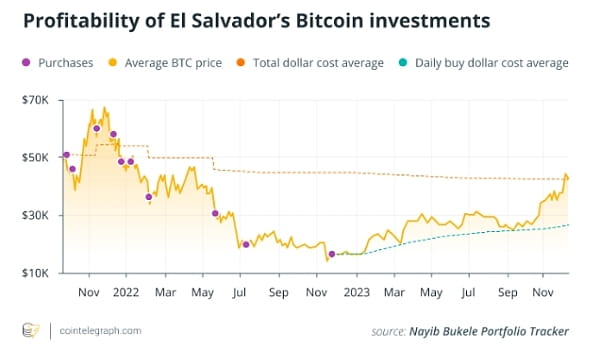 Profitability of Bitcoin Investment in El Salvador
Irresponsible speculation?
Given the ongoing crypto market volatility, some have questioned whether Bitcoin is an appropriate investment for sovereign governments, especially with such severe debt burdens.
“At a time when extreme poverty and food insecurity are increasing, speculating with public resources is irresponsible,” said Lourdes Molina, a senior economist at the Central American Fiscal Institute. “Taxpayers’ funds allocated for the implementation of the Bitcoin law represent a high opportunity cost for Salvadoran citizens.”
Molina added that the funds invested in Bitcoin should have been used to finance public goods and services. The new law also had other unintended effects:
“The economic risks posed by the implementation of the Bitcoin Law remain, especially those related to the possibility of turning the country into a tax haven and facilitating money laundering. Other risks have been contained by the non-mass use of the currency.”
George Selgin, senior fellow and director emeritus of the Cato Institute’s Center on Monetary and Financial Alternatives and professor emeritus of economics at the University of Georgia, noted that the country’s monetary experiment was initially envisioned to have a scope far beyond large-scale cryptocurrency investments:
“El Salvador’s Bitcoin initiative was not sold as a high-risk investment strategy — even though it was that. It was an attempt to ‘bitcoinize’ El Salvador’s dollarized economy. In that regard, it was a complete failure.”
In late 2022, Cointelegraph reporter Joseph Hall traveled to El Salvador to see if he could survive in the country using only Bitcoin for payments. For two weeks, “I tried to pay for every item with Bitcoin or Satoshi (small amounts of Bitcoin). I failed.”
Selgin noted that in El Salvador, the U.S. dollar remains overwhelmingly the “medium of choice” for payments, “for everyone except some Bitcoin tourists.” Despite remittances being promoted as a natural use for Bitcoin, Salvadorans living abroad do not use it to send money home. “I cannot understand why other countries would want to follow such an example,” Selgin said.
Part of a bigger plan
Still, it’s important to put the state’s Bitcoin spending into a larger context. It’s just one element in El Salvador’s economic independence plan. Bukele has also implemented a series of bond buyback programs to recover the country’s debt situation and expand the tax base “by welcoming immigrants and citizens back home,” Ardoino said, adding:
“El Salvador now has one of the best performing bonds among emerging market countries and is seen as a safe and attractive tourist destination. The country’s decision to adopt Bitcoin has brought them investment, tourism, and international recognition.”
“To get this project off the ground, Bukele had to sell it with high — perhaps even excessive — expectations,” Tawil said. “No one really expected Bitcoin to become a medium of exchange any time soon.”
Tawil went on to say that this part of the experiment is “premature,” largely because Bitcoin still has usability flaws. “It’s not easy enough yet — not as easy as a credit card, but it will get easier,” he predicted.
Meanwhile, El Salvador’s positive returns on its Bitcoin portfolio, if sustained, could draw attention from other sovereign nations. For example, inflation-plagued Argentina has a new president, Javier Milei, who is interested in cryptocurrencies and could borrow some elements of El Salvador’s Bitcoin Pioneer program. In Argentina, many people still don’t have bank accounts, so Bitcoin could help.
Failure as a medium of exchange?
Lack of retail adoption remains a pain point. Two years ago, El Salvador made a lot of efforts to encourage citizens to use Bitcoin for retail purchases. The government spent millions of dollars distributing Chivo wallets and small amounts of (free) BTC to citizens, but the end result was disappointing.
“Whenever you launch something very different, you can’t expect instant success and immediate results,” Ardoino responded. “People forget that when credit and debit cards were first introduced, it took 10 years for them to gain acceptance in Europe, and it wasn’t until 20 years later that we saw full coverage.”
As for investing in risky assets, “the government has certainly been investing,” Green said. “But El Salvador is very angry about investing in Bitcoin — more than anything else.”
He added that it was "puzzling" why the IMF, an organization whose mission is to "achieve sustainable growth and prosperity," was worried about future-proofing solutions.
“The S&P 500 is in a bear market for the first time since March 2020,” Green continued. “Many investments are underwater,” but “savvy investors don’t panic sell during a bear market.”
What do industry insiders think?
Overall, is it too early to tell whether El Salvador’s Bitcoin journey has been a success or a failure?
Green commented: “This is a mixed report, but that’s always the case when launching new fiat and digital currencies with no roadmap.”
Tawil called the country’s BTC gamble “100% successful.” Looking at the cost basis of its purchase of Bitcoin — these “will probably never be seen again,” at least for any sovereign nation. He believes El Salvador was prescient.
Instead, economist Selkin argues that the small profits El Salvador has made so far on its Bitcoin splurge are largely inconsequential. Things could easily go south: “No responsible government would take a risky gamble with tax money, and it would be completely irresponsible for a poor country to do so. Whether this gamble pays off is not actually important.”
Molina also gave El Salvador a low score for bitcoin investment. “To this day, the arguments to attract investment, create jobs or promote financial inclusion have not materialized. The only thing that is socialized is the cost that citizens have to bear,” she said.
In contrast, Adoino considers El Salvador’s bitcoin turn “a success so far.” Bitcoin has brought spin-off benefits in tourism and investment to the country, and “now El Salvador is developing an entire financial sector based on digital assets. [...] On its current trajectory, El Salvador is poised to become the new financial hub of Latin America.”
Green pointed to a Sept. 8 report by Spanish banking giant Santander that praised El Salvador’s new “market-friendly approach to policy management” and its growing willingness to repay debt. Santander commented that the rise in El Salvador’s bond prices “almost defies gravity” and that the country may soon be able to access European bond capital markets.
Green added that it should also be remembered that El Salvador has "a dismal history of defaulting on its international debts," but "according to most experts, it will take until at least 2029 before El Salvador is likely to do so, which is pretty remarkable given the history."

