


XRP and Bitcoin Spark (BTCS) have gained a lot of attention in the crypto community due to their unique features. Let’s delve deeper into their technical differences and see how they contribute to the growth of cryptocurrencies.
What is Ripple?
XRP is a cryptocurrency created by Ripple, whose main focus is to improve international remittances for financial institutions by enabling them to settle transactions quickly, efficiently, and at a low cost. XRP is used as a bridge currency in the Ripple network, providing liquidity and facilitating the exchange of different currencies.
Unlike many other cryptocurrencies, XRP is pre-mined by the Ripple team with a fixed supply of 100 billion.
XRP also runs on the XRP Ledger, a blockchain that features the Ripple Protocol Consensus Algorithm (RPCA), which relies on a smaller group of validators to manage the transaction verification process. However, this somewhat centralized approach has sparked debate within the crypto community.
Ripple Price
XRP price has shown a sustained sideways trend over the past two weeks, oscillating within the range of two converging trendlines, and the cryptocurrency has given up all the gains it made following Ripples’ partial victory over the SEC.
However, analysts believe that XRP’s price could surge higher, indicating overall bullish sentiment in the wider cryptocurrency market, as well as favorable developments in the XRP ecosystem, such as the partnership between XRPL Labs and Xahau Ledger.
What is Bitcoin Spark?
Bitcoin Spark is a new crypto project that aims to seamlessly integrate real-world applications with the security, scalability, and decentralization of blockchain.
Many devices around the world have idle processing power that is not being used. Bitcoin Spark seeks to affordably and efficiently “rent” this power to organizations or individuals that are in dire need of additional computing power. The Bitcoin Spark network uses its own proprietary consensus, called Proof of Process (PoP), which rewards users for validating transactions and contributing their processing power.
The network accommodates a large number of validators by having a large number of nodes. It also ensures a fairer reward distribution by using PoP and an algorithm that exponentially reduces the reward per additional processing power.
Users simply install the Bitcoin Spark native app and grant it access to their device’s processing unit to participate in network validation.
The application will run in an isolated virtual environment that will not interfere with the device's operating system functions and will automatically adjust processing power consumption by taking into account battery life and concurrent device usage requirements.
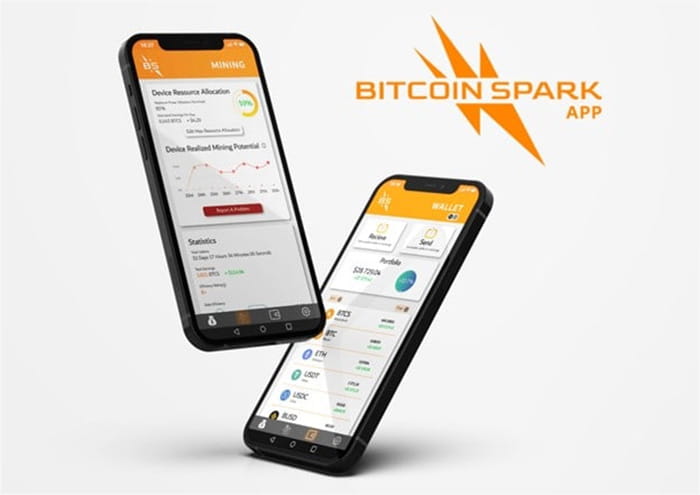
The validator's processing power will then be transmitted as remote computing power to Bitcoin Spark clients, resulting in decentralized CPU/GPU leasing. Clients will be required to pay with BTCS, and the revenue generated will be sent to network validators, providing an additional revenue stream. The ability for unlimited devices to provide processing power to Bitcoin Spark indicates unlimited product potential.
The Bitcoin Spark app and website will contain small advertising space. The community will monitor the ads to ensure they comply with the rules and regulations, ensuring the credibility of the platform and its ads. Advertisers will also need to pay with BTCS.
What Bitcoin Spark goes beyond is the support for smart contracts and decentralized applications (Dapps). The network is built with a multi-layer system, including a smart contract layer that allows both high-level and low-level programming languages. This layered infrastructure ensures the scalability and diversity of the Bitcoin Spark ecosystem.
Bitcoin Spark Price
Bitcoin Spark (BTCS) is currently selling for $2.25 in the fourth phase of its initial coin offering (ICO). The launch price of BTCS was set at $10, which indicates that investments in this phase are expected to increase their investment by about 489%. Investors can also receive other benefits, including a 10% bonus.
The ICO, which plans to distribute 19.05% of the 21 million BTC capped supply, has received a large amount of investment and many positive reviews, indicating the potential for more growth and adoption.
in conclusion
The future of XRP and Bitcoin Spark (BTCS) is promising as they embody the diversity and innovation that defines the dynamic cryptocurrency landscape. #XRP #Spark

