

Original title: “Can OpenSea Bounce Back?”
Original author: William M. Peaster
Original translation: Lucy, BlockBeats
Editor's Note: As the world's first and largest market for discovering, collecting and selling NFTs, OpenSea's NFT trading volume and market share have recently declined sharply. Coupled with layoffs, royalties and the Sisyphus incident, OpenSea's development is facing serious resistance.
William M. Peaster, senior writer at Bankless, used Blur as an example to analyze OpenSea's development potential and how to deal with resistance. He believes that at present, OpenSea has not yet released its own token or its own L2, which are two potential trump cards. In addition, he also pointed out that even though Blur is currently booming, users will eventually choose to return to OpenSea in the absence of airdrop incentives.
Once an undisputed giant in the crypto space, OpenSea has admittedly faced some serious headwinds as of late.
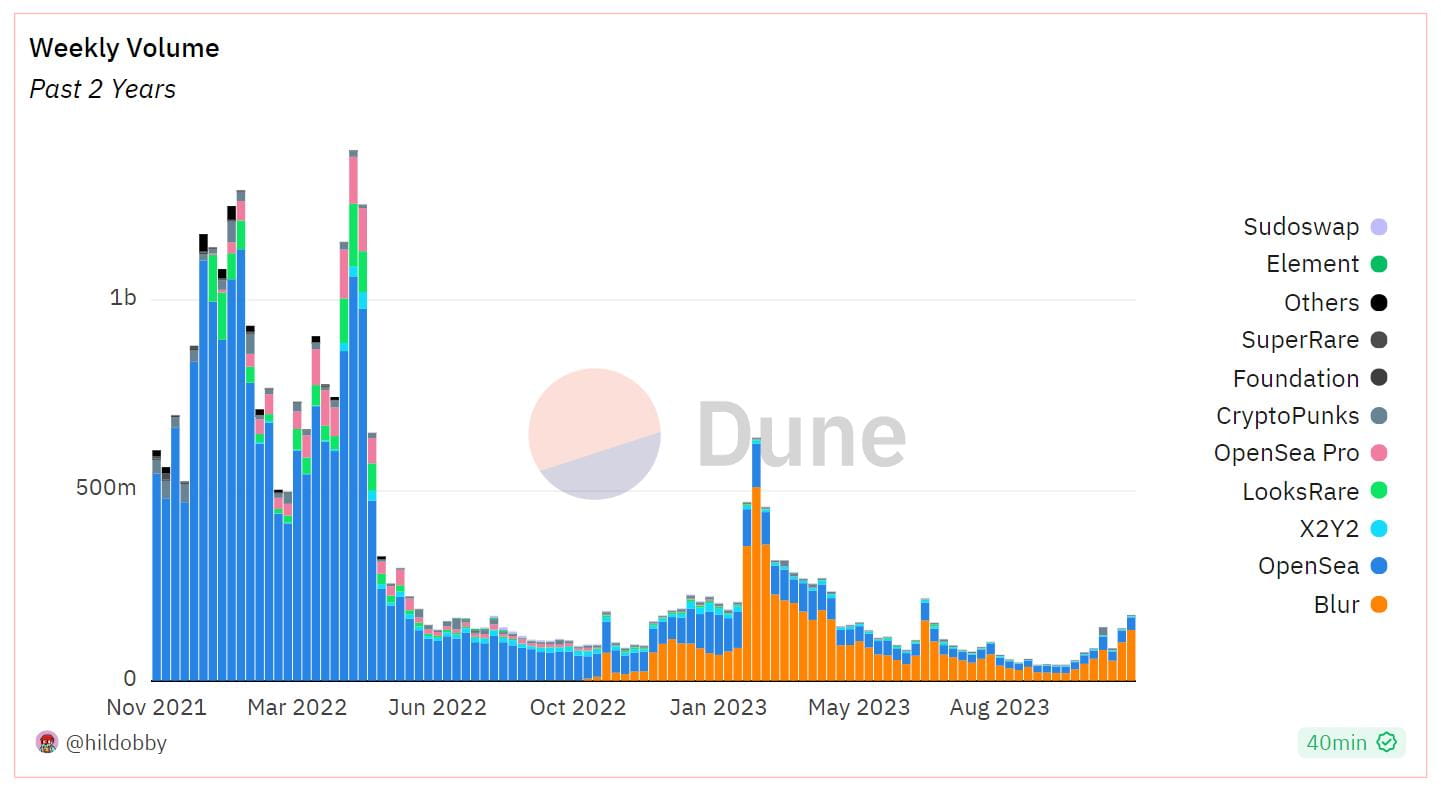
On one hand, NFT trading volume is down significantly from its 2021 peak, as is OpenSea’s market share by volume. Recently, the market has also faced massive layoffs, VCs’ expectations have been drastically reduced, and $BLUR is rising again.
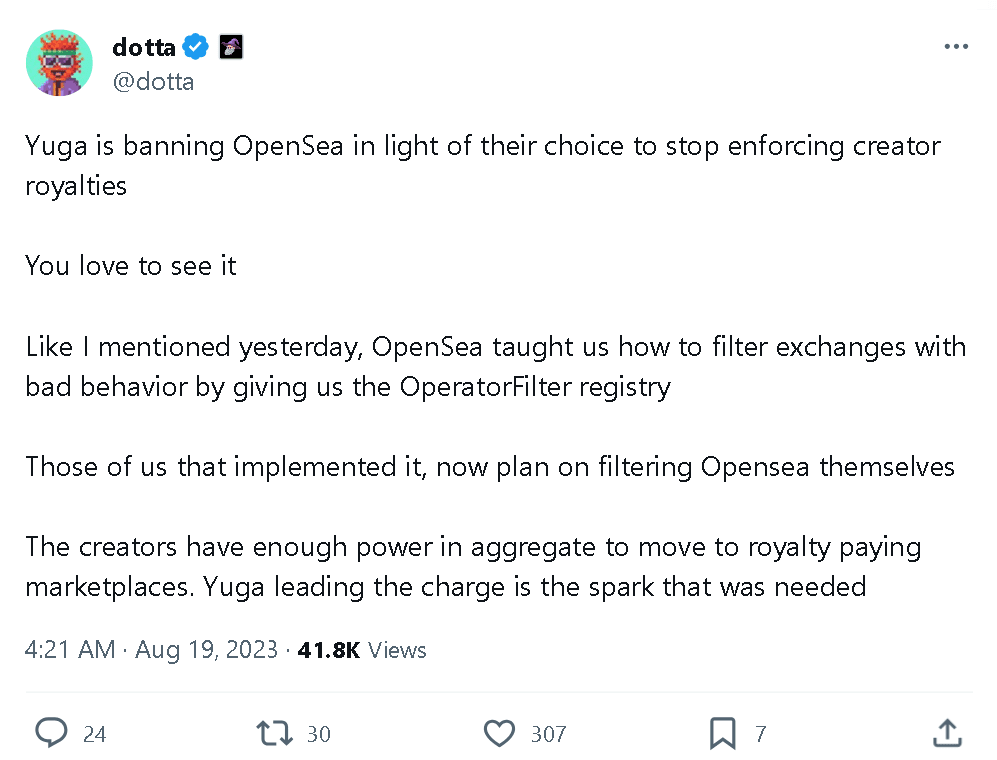
The platform is also dealing with an ongoing royalty dispute that pitted it against Yuga Labs, the creator of Bored Ape Yacht Club. The split led Yuga to begin developing its own marketplace in partnership with emerging OpenSea competitor Magic Eden.
Now that OpenSea is in trouble, can it return to its previous dominance in the NFT space? It’s possible. That said, OpenSea will need to leverage its strengths to achieve a lasting resurgence.
Humble Giant
Those strengths include executives like CEO Devin Finzer, who remains one of the most respected leaders in the space despite OpenSea’s recent setbacks. OpenSea also has strong brand recognition and, even during the recent bear market drop, has more users than most crypto projects have.
But we’ve also heard your feedback loud and clear: sometimes, OpenSea feels like a follower, not a leader. That’s not who we want to be. We want to move forward with speed, quality, and conviction, making more meaningful bets.
—Devin Finzer, November 3, 2023
The marketplace also offers a range of premium services such as Deals, Studio, and OpenSea Pro, which remain my favorite NFT marketplace experience to date.
Beyond that, OpenSea has yet to release its own token or its own L2, so it still has two potential trump cards up its sleeve.
In my opinion, giving away OS tokens will bring more attention and interest to OpenSea than BLUR has brought to Blur so far. This will be a huge move that will generate huge activity and can help the platform achieve balance.
OpenSea could launch its own L2 with or without a native token first. So far, Base and Zora Network have both had great success with L2 and have used ETH as gas so far. If OpenSea goes deeper into this layer and follows the Frame playbook by deploying an NFT-centric L2, it will automatically become a major competitor in the Ethereum Rollup scene.
Blur and betrayal of values
As we discuss solutions, it’s worth reflecting on one thing: Two years ago, at the peak of the NFT bull market, OpenSea’s one move caused it to lose its leading position, which is incredible.
Where things really started to go wrong for OpenSea was when it began trying to compete directly with NFT marketplace Blur. In order to combat this traffic-stealing threat, the platform betrayed many of its original creator-centric values.
Blur has always structured and marketed itself as a platform for “professional traders,” so it’s no surprise that the platform has increased its financialization efforts, downplayed NFT visuals, and shied away from secondary royalties set by creators.
Despite its notable activity, it will likely never be home to the community of creators that made OpenSea dominant in the first place. But in its effort to catch up to Blur and win back sales, OpenSea has backpedaled on secondary royalties, alienating many of its core users, from small independent artists to large studios like Yuga Labs.
Of course, I do think OpenSea could have had its cake and eaten it too. The platform could have kept creator-set royalties on its main platform and only kept optional royalties for OpenSea Pro to align its fork with a direct competitor to Blur. Instead, top creators went to war with the core market and looked elsewhere for companies whose values aligned with theirs.
Ultimately, I don’t think the reason most users left OpenSea and chose Blur was because of the low fees. Instead, most of the Blur volume was chasing the token incentive, i.e. airdrop mining $BLUR.
So if OpenSea started enforcing creator royalties again, launched a governance token and "OpenSea Network" L2, and started a public reward system for OpenSea Pro users, you have to admit that they would be in a better position than they are now.
In fact, the demand for the NFT space is broader than Blur addresses. Blur's "advanced trading" niche is exactly that. Take away Blur's token incentive advantage, and I think, all else being equal, you'll see a lot of people return to OpenSea.
As an NFT power user, I appreciate the more casual feel of OpenSea UX compared to the ultra-finance vibe of Blur. NFTs are a new type of cultural item filled with social magic, and I simply don’t feel that reality on Blur. Interestingly, I get the feeling that many other people feel the same way.
So, to get OpenSea back to its former glory and beat the competition, I suggest fighting tooth and nail on one front with OS tokens + L2 to win back degens, while returning to its values with a newer royalties + casual UX approach to win back creatives and more casual NFT enthusiasts.
The marketplace is about to unveil its 2.0 vision, so we’ll see if it follows the same lines. I will say that it’s still hard to say whether OpenSea can achieve the same dominance as before, especially with the rise of new challengers, so the platform definitely faces a battle.
I believe they have the ability, but now only time will tell.
Original link