

Source: Frank, Foresight News
On-chain data shows that due to the recent drop in CRV prices, Curve founder Michael Egorov deposited another 38 million CRV (US$24.5 million) into Aave yesterday to reduce his own lending liquidation risks.
In this article, Foresight News will give you a brief understanding of how much CRV the founder of Curve has currently pledged in Aave, how much money he has borrowed, where he has spent it, and what impact it may have on the future market?
How much money was borrowed on Aave?
DeBank data shows that as of the time of writing, Curve founder Michael Egorov has deposited a total of more than $180 million in assets into Aave V2, mainly 277 million CRV (about $178 million).
He has borrowed 64.23 million USDT from Aave V2, and the current health coefficient of this address in Aave V2 is 1.68.

In addition, he deposited more than 14.1 million CRV (about 9.09 million US dollars) into Aave V3 and lent out about 2.78 million USDT and 743,000 USDC.
The current health factor of this address in Aave v2 is 1.68.
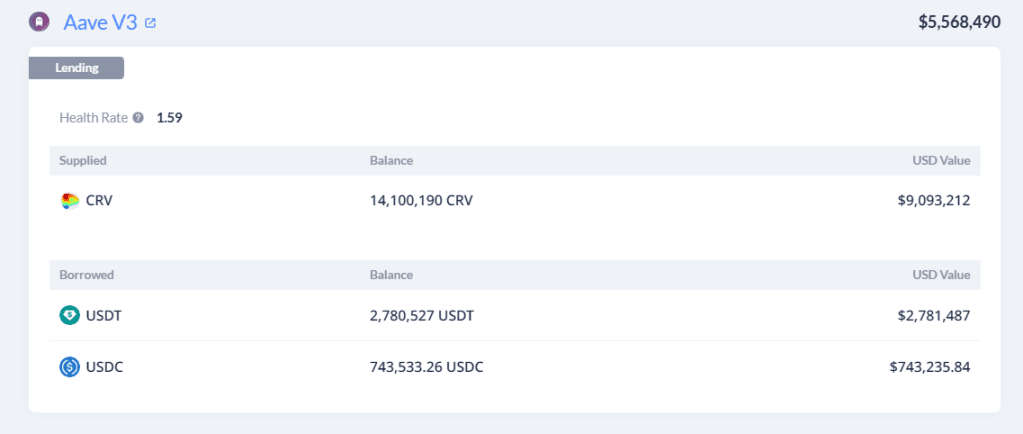
In summary, as of now, the founder of Curve has deposited 291 million CRV (US$187 million) into Aave and borrowed approximately US$67.75 million in stablecoins.
Where did the borrowed money go?
According to Lookonchain data monitoring, the funds that Curve founder Michael Egorov has borrowed through Aave mortgage in the past are mainly divided into three destinations:
37.7 million USDT deposited into Bitfinex;
51 million USDC was transferred to Wintermute Trading;
1,420 USDT were used to purchase ETH and USDC during the USDC decoupling period;
First, he deposited a total of 37.7 million USDT into Bitfinex, of which 31 million USDT were transferred from April 10 to April 14. During this period, the price of Bitcoin rose from US$28,000 to more than US$30,000. If he held it until now, he would still be in a loss.
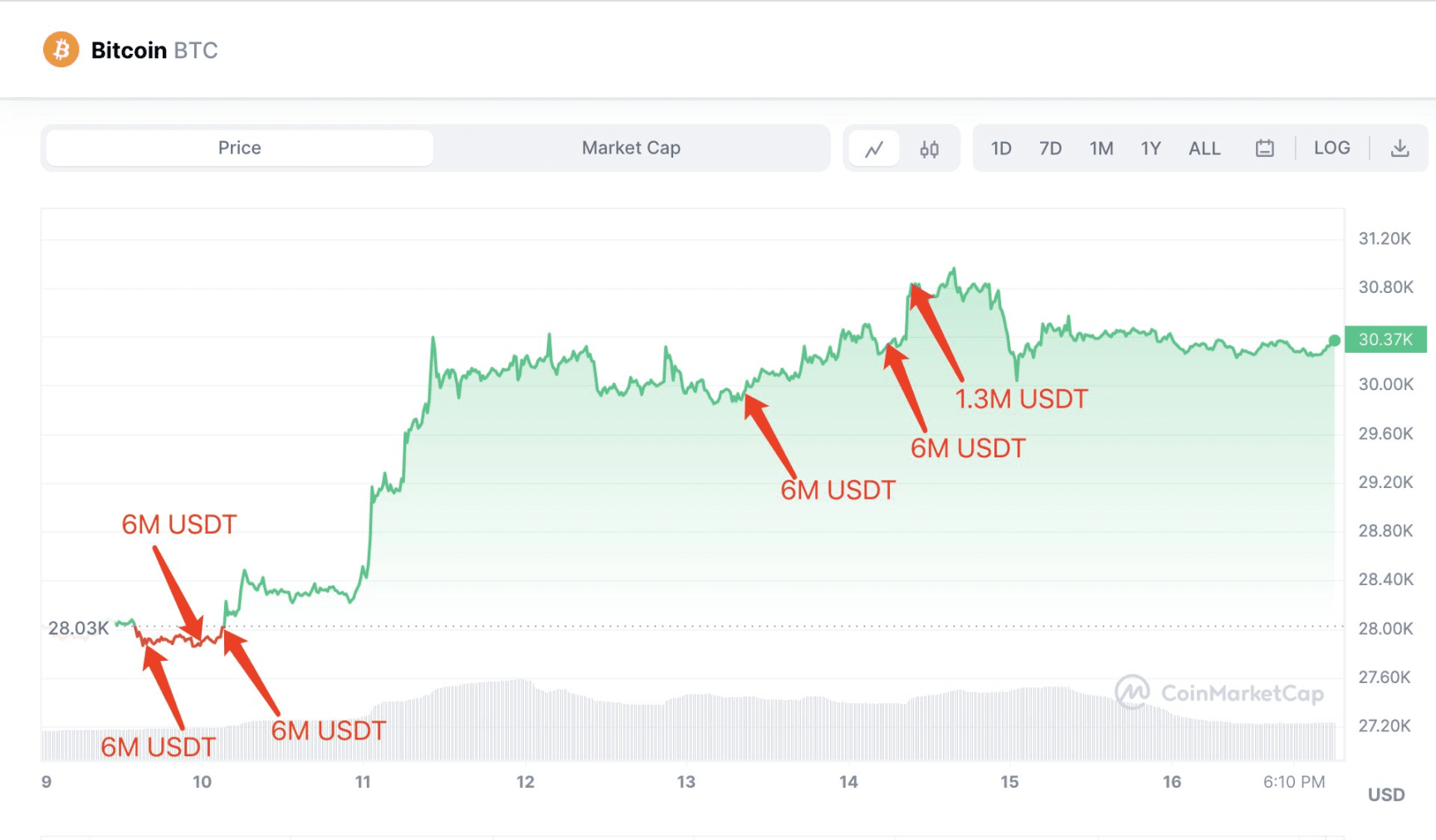
From June to September 2021, he also transferred 4.74 million USDT to the address starting with "0xb10f", mainly used to provide liquidity for Curve, and deposited a total of 4 million USDT on Kraken.
Since May 17 this year, he has transferred a total of 51 million USDC to Wintermute Trading through the address starting with "0x9660".
In addition, during the USDC depegging period in March this year, he borrowed 6.8 million USDT and purchased 4,014 ETH at a price of US$1,694; and borrowed 7.4 million USDT to purchase 7.8 million USDC at a price of US$0.95. This is a clear profit at present.
"Cash out" or "reluctant to sell"?
CoinGecko data shows that the current circulating supply of CRV is 852 million, which means that the 291 million CRV that Michael Egorov holds as collateral in Aave accounts for 34.15% of the circulating supply of CRV!
For Michael Egorov, he holds more than one-third of the CRV circulating shares, but he did not sell them directly for profit. Instead, he exchanged funds for collateral in the loan agreement to avoid direct selling pressure on the secondary market. This seems to be a "reluctant to sell" choice.
But from another perspective, such a large amount of CRV is difficult to sell smoothly in the secondary market, and Aave's mortgage lending provides an option to "cash out" with minimal impact on realization.
This also means that the 291 million CRVs currently used as collateral are like a hidden reservoir, posing a huge threat to the Curve ecosystem and the Aave protocol. It should be noted that the CRV long-short battle in November last year eventually resulted in Aave incurring approximately US$1.6 million in bad debts.
Therefore, if the market continues to fall, resulting in continued tight liquidity, once the CRV price falls to the liquidation point, it is likely to cause a chain stampede.
It is even possible that someone has precisely ambushed this large liquidation point (although Aave has banned users from borrowing CRV since the CRV long-short war, which has reduced the risk of CRV being shorted to some extent), as dForce founder Yang Mindao tweeted:
"Aave V2 has no deposit limit, which makes it impossible to control collateral exposure. The only thing that can be done is to increase the USDT borrowing cost and use its own currency as collateral for leverage. It seems that it is reluctant to sell, but in fact it is an inducement to short sell."
It is worth noting that Curve founder Michael Egorov has also been in a "troubled time" in public opinion recently:
- First, on May 28, the media broke the news that he and his wife Anna Egorova bought two luxury houses in Melbourne, spending a total of US$41 million, covering an area of 4,251 square meters;
- Then on the 9th of this month, three VCs, ParaFi Capital, Framework Ventures and 1kx, sued Curve founder Michael Egorov for allegedly engaging in fraudulent activities and handling trade secrets, claiming that they invested 1 million US dollars in Curve in 2020, and Michael Egorov then deposited the investment funds into Curve's liquidity pool. The three VCs did not receive CRV tokens or a refund.
Original link