


 The “wang-scraping era” of big hair: Falcon Finance (@falconfinance) has recently made new moves again
As a general collateral layer project, it’s crucial to have a sufficient number of minting and usage scenarios
Therefore, just yesterday Falcon announced the launch of its regulated asset tokenization pipeline for RWA issuance. Tokenized GPU Forward (power infrastructure financing) is the first deal under this framework, and this article will break it down in detail
It’s not complicated. First, let me share my understanding in plain language ⬇️
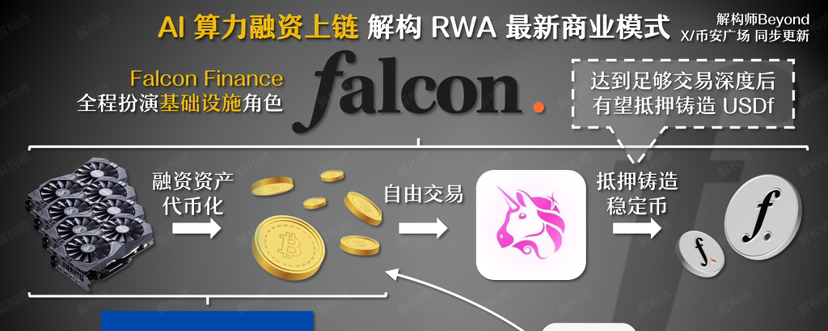
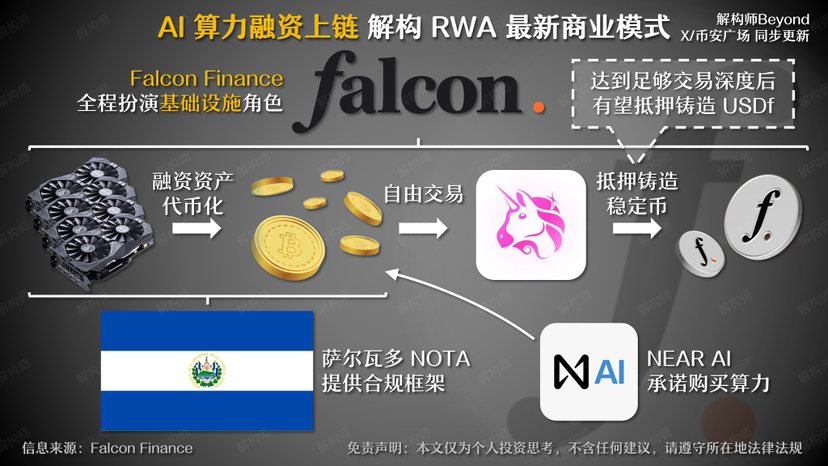
Someone wants to buy a large amount of GPUs to build AI compute infrastructure, but they don’t have enough money and need financing. Under this Pipeline framework, Falcon plans to compliantly tokenize this real financing, turning it into an on-chain asset that can be traded on the market and can form pricing. In the future, once conditions are met, it may also be used as collateral for minting the stablecoin USDf
Although the steps aren’t complicated, what role do the different stakeholders play in each part? It’s worth exploring in more depth ⬇️
1/ Falcon’s role: build infrastructure
Falcon itself doesn’t buy GPUs or sell computing power. What it does is wrap this real financing into an asset that can be used on-chain. Specifically, there are three things
- Issue the financing tokenized through a compliant framework
- Let the token trade on open markets and form a price
- After the asset forms enough trading volume and pricing, consider accepting it as collateral to mint USDf
You could say that Falcon is building a bridge from real-world financing to on-chain liquidity—in crypto terms, it’s foundational infrastructure
2/ El Salvador’s role: provide a compliant regulatory framework
This asset can’t just be put on-chain. El Salvador already has a dedicated “Digital Asset Issuance Law,” regulated by CNAD
The actual issuance is carried out by the locally licensed entity NOTA
With this framework in place, Tokenized GPU Forward counts as a regulated RWA issuance—not an unregulated token
Previously, Tether Gold XAU₮ also followed the same regulatory path, showing that this system has already been proven to run
3/ NEAR AI’s role: backstop future revenue
Once the GPUs are bought, someone has to use them and pay for them—only then can this financing be supported by cash flow
In this setup, NEAR AI acts as an anchored buyer—committing to purchase the computing power that these hardware assets will generate in the future. With a relatively certain demand-side, investors have greater confidence in the asset, and pricing becomes easier to establish
RWA is a well-worn topic—tokenizing this and putting it on-chain isn’t new. But Falcon’s main breakthrough is that it tries to bring RWA assets into its broader, regulated Tokenization Pipeline and link it with the stablecoin business, laying out a relatively complete economic model ⬇️
For the asset itself, it’s a shift from a static certificate to a composable financial instrument
Real-world assets → compliant issuance → open trading → form price and liquidity depth → become eligible collateral → unlock new on-chain liquidity
Finance is called the mother of all industries, because it improves capital flow efficiency—so buyers spend less and sellers earn more. In Falcon’s RWA pipeline, led by GPU financing, this is reflected pretty directly
