


In the past, to understand a company, we had to rely on connections, gossip, and even whispers in the break room.
Nowadays, an app can tell you in one second who the company's shareholders are, whether it has been sued, how many trademarks it has, how many patents it holds, what positions it is currently hiring for, and what gossip there is about the boss...
'Checking companies' has become a daily action for professionals, investors, lawyers, journalists, and even ordinary workers.
This seemingly unremarkable business is scientifically known as 'business information inquiry.'
And now, it is this industry's pioneer that is about to knock on the door of the Shanghai Stock Exchange main board: Qichacha.
On October 10, 2025, Qichacha Technology Co., Ltd. IPO application was accepted by the Shanghai Stock Exchange main board, intending to raise 1.5 billion yuan, with CITIC Securities as the sponsor.
In 2024, the company's revenue exceeded 700 million yuan, and net profit reached 317 million yuan—this is already a rare profit level in the 'selling data' business.
The controlling shareholder and actual controller, Chen Deqiang, born in 1985, is a typical 'programmer entrepreneur'.
Since its founding in 2014, in ten years, he has transformed a 'WeChat small tool for checking enterprise information' into a 'commercial big data service platform' with 150 million registered users, covering thousands of industries including banks, securities, insurance, law firms, and manufacturing.
The significance of this matter goes far beyond the IPO of a single company.
It represents at least three signals:
1. It is the 'door knocker' of the 'data service/big data/credit information' track on the A-share main board; shifting from 'selling goods' to 'selling data', from traffic business to data business, the business model of digital China is growing.
2. It indicates the national guidance and encouragement atmosphere regarding 'data factors' and 'credit systems'; checking enterprises, checking bosses, and checking risks has become part of the social trust mechanism, reflecting the rise of a credit society.
3. As a commercial inquiry entry-type tool, if it successfully goes public, it will have a significant impact on the entire industry, the competitive landscape, and the strategic development of the company itself.
1. How did the business of 'checking enterprises' grow?
Qichacha was founded in 2014, positioned as a 'comprehensive service provider of commercial big data'.
Its core business is to transform data originally scattered in public information systems such as business registration, taxation, courts, trademark offices, and Credit China into structured, retrievable, and valuable products through technology (web crawling, cleaning, data integration, desensitization, association diagrams, knowledge graphs, AI models, etc.), allowing users to 'check everything with one click'.
In other words, Qichacha transforms 'original public data' into 'consumable commercial data products'. This processing capability from 'raw materials' to 'products' is one of its technological barriers.
Its business model is divided into two lines:
(1) C-end: an 'information tool' for individual members
On the C-end, Qichacha's app, mini-program, and web version provide basic inquiry services for individuals.
Basic information is free, while in-depth functions (equity penetration, risk alerts, enterprise maps, etc.) require membership payment.
As of June 2025, Qichacha has accumulated over 150 million registered users and over 1 million paying users.
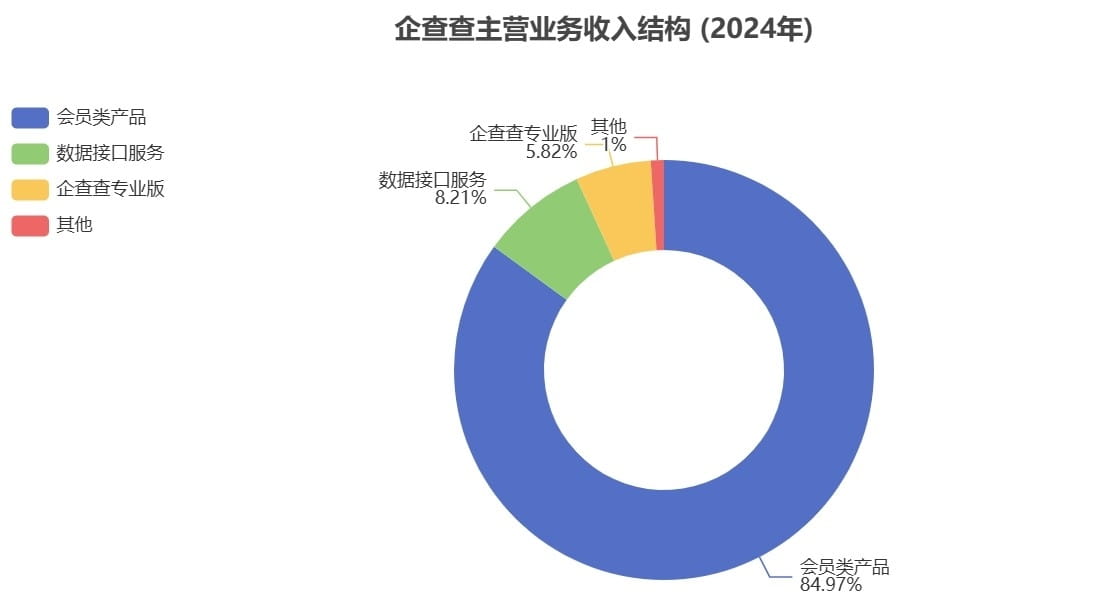
In 2024, membership product revenue is 602 million yuan, accounting for 84.98% of the main business.
In other words, its revenue mainly comes from C-end individual members—this is completely different from most ToB data service companies.
Every time you input a company name, Qichacha's backend retrieves data from multiple databases, including business registration, courts, trademarks, patents, recruitment, bidding, etc., to generate a real-time 'enterprise profile'.
The cleaning, desensitization, tagging, establishing relationships, and visualization of these data constitute its true technological barrier.
(2) B-end: serving as a 'data mid-platform' for enterprises
Qichacha's B-end clients include banks, securities firms, insurance companies, law firms, internet platforms, manufacturing enterprises, and more.
These clients purchase Qichacha's API data interfaces, risk control systems, and credit reports for loan approvals, anti-fraud, due diligence, and supply chain risk assessments.
For example, a bank can directly access Qichacha's enterprise credit data before issuing a loan, identifying enterprise risks in seconds; an insurance company can use its litigation data to assess potential risks for clients. These are all solid 'necessary businesses'.
As of now, Qichacha has served:
✅ 5 major state-owned banks
✅ 12 joint-stock banks
✅ Over 50 securities firms
✅ Over 80 insurance companies
✅ Over 200 law firms
✅ Hundreds of China's top 500 companies.
It has become one of the underlying data suppliers for the government and enterprise risk control systems.
Qichacha Professional Edition adopts an annual subscription or module-based charging model, with its revenue accounting for about 5.82% in 2024. Data interface services belong to B2B solutions, accounting for about 8.21% of revenue in 2024. Although the overall ratio is not high, the gross profit margin is high and the stickiness is strong, making it a key engine for future growth.
This means—Qichacha is no longer a small tool for 'checking boss backgrounds', but rather an underlying data supplier for the risk control, investment research, and credit assessment systems of many institutions.
Its underlying logic is essentially China's version of 'data as production materials'.
2. An entrepreneur's story: from 'Suzhou programmer' to 'king of data'
The company's founder, Chen Deqiang, was born in 1985 and is from Wenzhou, Zhejiang.
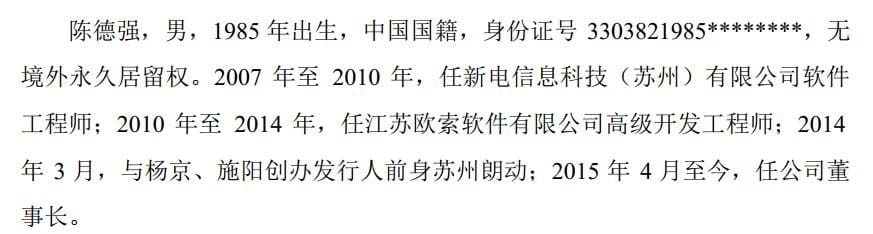
In 2007, he became a software engineer at Suzhou New Electric Information Technology Company, and later worked as a senior development engineer at Jiangsu Ouso Software. Those years coincided with the rapid popularization of China's internet infrastructure, as WeChat was just launched, and platforms like Dianping and Weibo were thriving.
At that time, China was still in the 'information opaque era': to learn about a company, one had to rely on friends' introductions or media reports. But he keenly saw a trend—information transparency.
In 2014, the state issued the (Social Credit System Construction Planning Outline (2014-2020)), encouraging social credit institutions to strengthen the integration of publicly disclosed government credit information and non-government credit information, and actively promote the social application of credit products.
It was also in that year that Chen Deqiang and his partners created the prototype of the 'Qichacha' project at Southeast University in Suzhou.
Initially, they did not start with 'inquiry/credit services', but due to the need to rent sports venues and solve the pain of 'finding the real owner', they came up with the inquiry tool.
They initially created a WeChat public account assistant tool: by entering the venue name, one could find business registration, legal person, equity and other public information. This auxiliary tool was repeatedly mentioned by friends in business as 'easy to use', gradually evolving into a real product direction. After optimization, unexpectedly, this small feature became popular: within three months of launch, users increased from 200 to 70,000.
In the following years, Qichacha continuously made inroads:
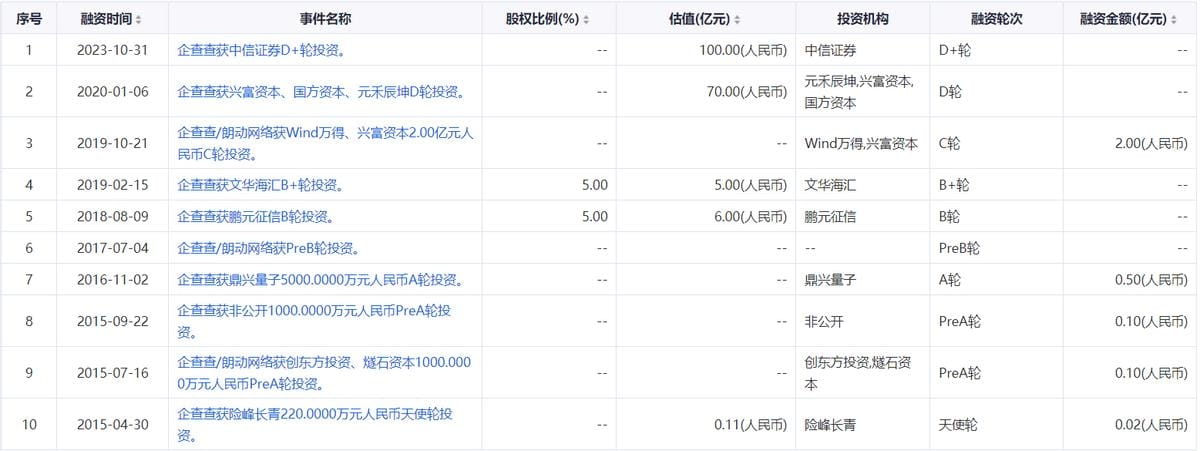
In 2015, it received its first financing of 2.2 million yuan, expanding the team size;
In 2017, it intensified market promotion, doubling its user base within a year and achieving profitability;
In 2019, it received several hundred million yuan in Series C financing led by financial data giant Wind, entering a rapid expansion phase, with employees growing from over 100 to over 500, and the product line continuously enriching.
As of 2023, Qichacha has grown into an industry 'unicorn' with over 800 employees nationwide, establishing its own headquarters building in Suzhou.
Chen Deqiang has also received multiple honors, such as the 'Zhejiang Business Annual Innovation Figure' in 2018 and the 'Hurun Under 40 Entrepreneur Pioneer' in 2023.
Over ten years, Qichacha has achieved a leap from 'tool' to 'platform'—its database now covers over 300 data dimensions, including business registration, taxation, judicial litigation, intellectual property, public opinion, investment and financing, and equity penetration, becoming one of the most systematic enterprise profiling systems in the country.
As of 2025, the company has 73 invention patents, making it one of the earliest companies in the industry to pass the central bank's credit record filing and the first company to pass the national internet information office's data outbound security assessment.
This is not the usual 'internet entrepreneurship', but a ten-year 'data industrialization revolution'.
3. Track observation: the 'golden age' of the commercial inquiry industry
The industry in which Qichacha operates is the commercial information inquiry and enterprise credit service sector. Over the past decade, this industry in China has experienced rapid growth from nothing, driven by both policy promotion and market demand. Data services and credit services are gradually evolving from 'niche purchases' to 'infrastructure-type services'.
1. Market size: from tools to infrastructure
According to a report released by Zhaoshang Consulting (China Commercial Big Data Service Industry Blue Book), the market size of China's enterprise information big data service market was about 15 billion yuan in 2023, maintaining a compound annual growth rate of over 20%.
With the layering of multiple demands for enterprise digital transformation, financial risk control, credit system construction, government transparency, and digital government, this market is evolving from 'application-level tools' to 'underlying infrastructure'.
In the next five years, the industry is expected to exceed 30 billion yuan in scale and see the emergence of platform players similar to 'industry operating systems'.
Qichacha's advantage lies precisely in the formation of a flywheel effect between 'C-end user volume' and 'B-end government and enterprise services'—
C-end brings it brand exposure and massive behavioral data,
B-end brings stable revenue and higher gross profit margins,
and the two can enhance algorithm accuracy through data resonance.
At the policy level, the ('Data Elements ×' Three-Year Action Plan (2024-2026)) clearly states to 'support data companies in going public for financing'—Qichacha is one of the first batch of representatives accepted thereafter.
2. Competitive landscape: the battle of 'Tianyancha vs Qichacha'
Although the threshold is not low (data collection + cleaning + models + security compliance), this track is currently in a stage of 'increasing concentration'. Leading players are concentrating, and the barriers to entry for newcomers are higher.
Overall, the competitive landscape of the track in which Qichacha operates can be summarized as: two strong players (Tianyancha, Qichacha) leading the way, multiple strong players (Qixinbao, AiQiCha, etc.) catching up, with traditional institutions and emerging platforms coexisting. In the personal user market, Tianyancha currently has a clear advantage; but in the enterprise and professional user market, Qichacha also has its own loyal customer base and reputation.
If 'Baidu vs Sogou' defined the war of the search engine era, then 'Qichacha vs Tianyancha' defined the war of the commercial data era.
Tianyancha's founder, Liu Chao, has a background in Microsoft/Sogou and other technical fields.
Tianyancha was also very impactful in terms of brand and market entry—over many years, the market struggle between the two '查查' (checkers) has been very fierce.
Tianyancha has also had disputes with Qichacha regarding litigation/unfair competition in the past (reported by public media).
In 2023, QuestMobile data showed that Qichacha ranked first in mobile downloads and second in market share, only after Tianyancha. Together, the two account for over 80% of the domestic enterprise credit big data market, almost monopolizing the entire industry.
That is to say—users are more willing to download Qichacha, but the frequency of use is slightly lower than that of Tianyancha. Qichacha's advantages lie in compliance and data security: it is the first in the industry to pass the national internet information office's data outbound safety assessment and is also one of the early internet companies to obtain the central bank's credit record filing.
These compliance qualifications will become the 'moat' of the industry in the future. It can be said that this is a typical 'duopoly market', and the remaining competitive space is a contest of service depth and technical quality.
However, risks such as homogenization, data accuracy disputes, and privacy/compliance risks have always been industry challenges. Especially in commercial inquiries and credit services, there are many disputes over 'false reports, missed reports, delays in timeliness', as well as 'personal privacy/data security'.
4. Financial deconstruction: a good business with a gross profit margin of 90%
There is a famous law in the internet industry: 'the more traffic, the more losses.' The reason is simple—either traffic is expensive, or monetization is difficult. But Qichacha is exactly the opposite—it's one of the few internet companies that has achieved both 'traffic + profit'.
From the prospectus, Qichacha's operating revenue from 2022 to 2024 is 542 million, 673 million, and 708 million yuan respectively; net profit is 237 million, 295 million, and 307 million yuan respectively, with a net profit margin of about 40%. What does this mean? At the same revenue scale, Qichacha's profit margin can almost rival that of the 'software leaders' in the A-share market.
Why can it make so much money? There are three reasons:
First, it does not burn money to buy traffic. The main traffic for Qichacha comes from natural growth—users can find it themselves when they actively search for 'check enterprises' or 'check bosses'. This is a 'search native demand', not artificially stimulated by advertisements. This means Qichacha has a very strong 'user self-growth attribute', rather than relying on advertisements.
Second, it has a strong demand for products and stable payments. For individuals, checking enterprises is a 'high-frequency low-cost' necessity; for institutions, risk control due diligence is a 'low-frequency high-cost' necessity. The overlap of these two demands makes Qichacha's business model exhibit characteristics of 'high gross profit + strong renewal'. In 2024, the company's gross profit margin reached 91.7%, far exceeding that of most internet platforms.
Third, its technical costs are controllable, and the scale effect is significant. Data collection and structuring are one-time investments, with subsequent marginal costs being extremely low. In other words, once the database is built, the cost for each additional query user is almost zero. This is the 'data scale dividend'.
Qichacha's financial performance indicates that—this is a company that has truly achieved 'earning money from technology and information'. It did not rely on capital infusion but instead used product refinement, technological accumulation, and natural growth to steadily reach the IPO threshold.
In summary:
Qichacha relies not on 'traffic', but on 'repeat purchases'.
This is an extremely rare business model in the current capital market.
5. The strategic significance of the IPO
Why did Qichacha choose to IPO at this time?
There are three layers of reasons:
1. The window period of the capital market.
Regulatory authorities have continuously encouraged the 'digital economy' and 'AI+' industries, with data factors included in the national strategy. Qichacha is perfectly positioned at this opportunity. The reason Qichacha can enter the main board channel is that it has the highest degree of compliance in these critical areas.
It is the first company to pass the national internet information office's data outbound security assessment and has obtained the central bank's enterprise credit filing.
This not only allows it to do business, but also to become an 'industry benchmark'.
2. Funding for technological expansion.
It intends to raise 1.5 billion yuan for data center construction, AI model R&D, risk control engine upgrades, etc.—these are all high-cost investments.
3. Enhanced brand credibility.
In the B2B market, especially in the financial and government client sectors, being a listed company means 'trustworthy'. This is a natural advantage in Qichacha's business negotiations.
It can be said that this IPO is not just about financing, but also a kind of 'industry status certification'. Qichacha's choice to IPO at this time is not merely a financing action, but also a 'turning signal'.
Qichacha is expected to become the first data service provider to be listed on the A-share main board in the field of 'data/big data/commercial inquiry'. This 'first' is significant as it indicates higher capital market recognition, enhanced brand influence, and smoother financing pathways. The media has repeatedly emphasized the label of 'the first to sprint for the main board'.
It aligns closely with the national policy direction of 'data factors', 'credit system construction', 'industrial digitalization', and 'data infrastructure'. This policy dividend may open more public projects/government cooperation/platform resource entry. After 2023, 'data factors' were officially included in the production factor system. In 2024, the Ministry of Industry and Information Technology released (the Big Data Industry Development Demonstration List), and Qichacha was listed among them. This means: its business is no longer just 'commercial services', but a part of 'public credit infrastructure'. Becoming listed on the main board will also help it gain policy dividends, government procurement qualifications, and more B-end project cooperation opportunities.
In China, an economy with 170 million market entities, information symmetry remains a pain point.
Qichacha uses technology to bridge the trust gap, making business decisions more transparent.
From government regulation, financial risk control, to personal job seeking and supply chain cooperation—its existence makes it possible to 'see the other party clearly'.
In the past decade, China's social credit system construction has evolved from nothing.
Companies like Qichacha and Tianyancha are actually using a market-oriented approach to provide a 'technical interface' for the national credit system.
This significance transcends commerce itself.
The IPO will provide it with capital weapons for future expansion, enhance R&D investment, infrastructure investment, and market expansion capabilities. Especially in areas like AI, model upgrades, and large database construction, continuous funding support is needed.
However, there is also valuation and pricing pressure for the IPO: in the current capital market atmosphere, which is not particularly enthusiastic, the valuation discount for data/information service companies may be significant. Investors will scrutinize its moat, sustainable profitability, and risk control capabilities more strictly.
6. Some risks
Any commercial inquiry/credit/credit-related business cannot avoid the high-pressure line of 'compliance risk'. Qichacha is not without loopholes:
There is an example disclosed in the prospectus where the People's Bank of China's Jiangsu branch imposed an administrative penalty of 10,000 yuan for violating credit business management regulations.
Policy/Regulatory risks: Although the company claims that its data sources are mainly public/legally disclosed information + legal channels, in areas such as data collection, desensitization, user queries, cross-border data processing, privacy protection, API access security, personal sensitive information filtering, and the potential for false reporting/abuse, it remains a focus area of regulatory/social opinion. Multiple media have disclosed that it 'harbors personal information protection risks'. The industry has been repeatedly questioned in the past regarding 'personal information exposure' and 'excessive corporate disclosure';
Data accuracy issues. Many users in the industry complain about 'wrong checks/cannot check/delay/misjudgment', etc. For a platform that sells 'credit/risk judgment' services, if the error rate is too high, it will affect credibility, brand, user confidence, and compliance thresholds. Once a significant data error, privacy breach, or regulatory penalty occurs, the impact on the brand and trust could be extremely severe.
Intensified competition/impact from new entrants: Although a leading position has preliminarily formed, new technologies (AI, knowledge graphs/large models) may be used by new players to enter differentiated tracks.
3. Fluctuations in user willingness to pay: Although there are many C-end users, the proportion willing to pay is not high;
4. The impact of AI technology: Will future AI models that can automatically generate enterprise profiles diminish the value of manual inquiry platforms?
5. Post-IPO performance pressure: from private to public company, revenue growth and profit growth will be amplified challenges. In the next year or two, if the growth rate slows down or customer attrition occurs, the market may give negative feedback.
It can be said that the direction for Qichacha in the next decade is from 'checking enterprises' to 'understanding enterprises'. Its core competitiveness will also shift from 'who has more data' to 'who understands deeper'.
7. A new era has emerged
If one were to summarize Qichacha's ten years in one sentence, it would be—
'Starting from checking others, a new era emerged.'
In the industrial era, whoever controls energy controls growth; in the information age, whoever controls data controls trust.
Qichacha is worth paying attention to not only because of its profitability but also because it unveils a reality: as social trust shifts from 'acquaintances' to 'data', data services have become a new type of social infrastructure.
In the future, there may be more projects similar to 'infrastructure'.
\u003cc-223/\u003e
