

Original title: (In just 70 days, Polymarket easily collected tens of millions of dollars in fees)
Original author: Azuma, Odaily Planet Daily
On January 6th of this year, Polymarket officially bid farewell to the 'zero fee' model, starting to collect trading fees from the '15-minute cryptocurrency rise and fall' market. The specific fee ratio will change with the market's real-time odds— the closer the odds are to 0% or 100%, the lower the fees; conversely, the closer the odds are to 50%, the higher the fees, which can reach up to 1.56%.
Then, on January 28th, about three weeks after the fees began, we published an article (Data estimates that Polymarket can easily achieve over $100 million in annual revenue, provided that the assumptions are...) The article provided a static estimate based on Polymarket's trading volume and activity structure at that time: in the most conservative scenario, if the scope of the fee market remains unchanged, it is estimated that Polymarket could generate about $38 million in annual revenue; while in the most aggressive scenario, if Polymarket expands the fees to all markets, it is estimated that it could earn $418 million in annual fee revenue.
During our last revenue estimation for Polymarket, we struggled with a short observation period and too few calculable samples. However, two months later, we have re-estimated Polymarket's revenue expectations using richer data and found that the so-called "conservative" estimates were indeed too conservative, while the so-called "aggressive" expectations were not overly exaggerated.
Changes in revenue data
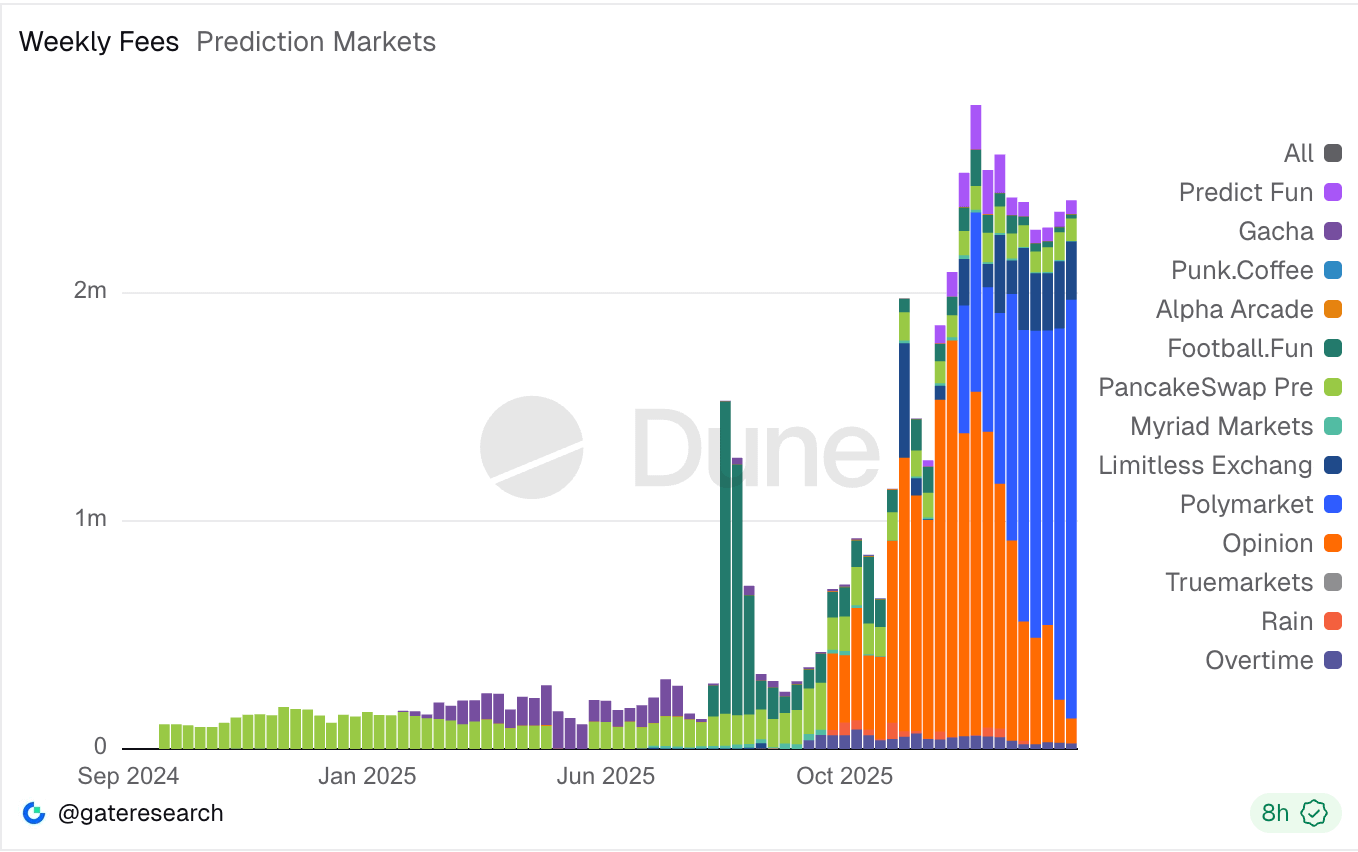
According to the data compiled by Gate Research on Dune, since the transaction fee was imposed on January 6, Polymarket has accumulated over $11.2 million in fee revenue.
In the most conservative manner, we estimate again statically that, if the trading volume and trading activity structure in related markets remain unchanged, Polymarket is expected to generate approximately $58.4 million in revenue annually.
However, this estimation method does not accurately reflect Polymarket's revenue-generating capabilities.
The reason is that Polymarket's revenue data is experiencing a visibly upward growth trend—over the past 10 weeks, the platform's fee revenues have been $560,000, $786,000, $633,000, $749,000, $1.08 million, $1.28 million, $1.35 million, $1.29 million, $1.63 million, $1.84 million... there has been significant growth almost every week.
Reasons for revenue growth
There are two reasons for the growth in Polymarket's fee revenue. First, Polymarket has expanded the scope of its fee markets; second, both the overall trading volume and the trading volume in fee markets are continuously increasing.
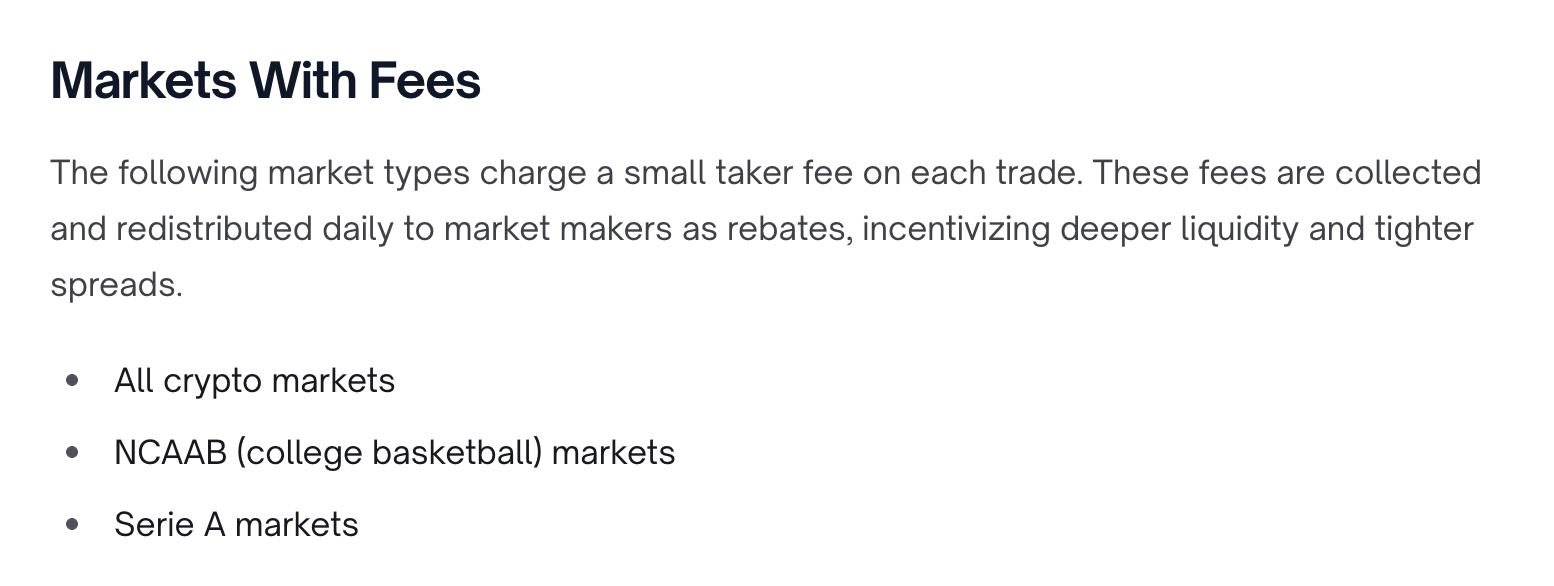
In terms of the scope of fee markets, Polymarket has expanded its fee mechanism to include all cryptocurrency-related markets since March 6. Additionally, it previously tested fee collection in sports markets such as NCAA and Serie A, but the former (cryptocurrency-related markets) remains the main source of fee revenue.
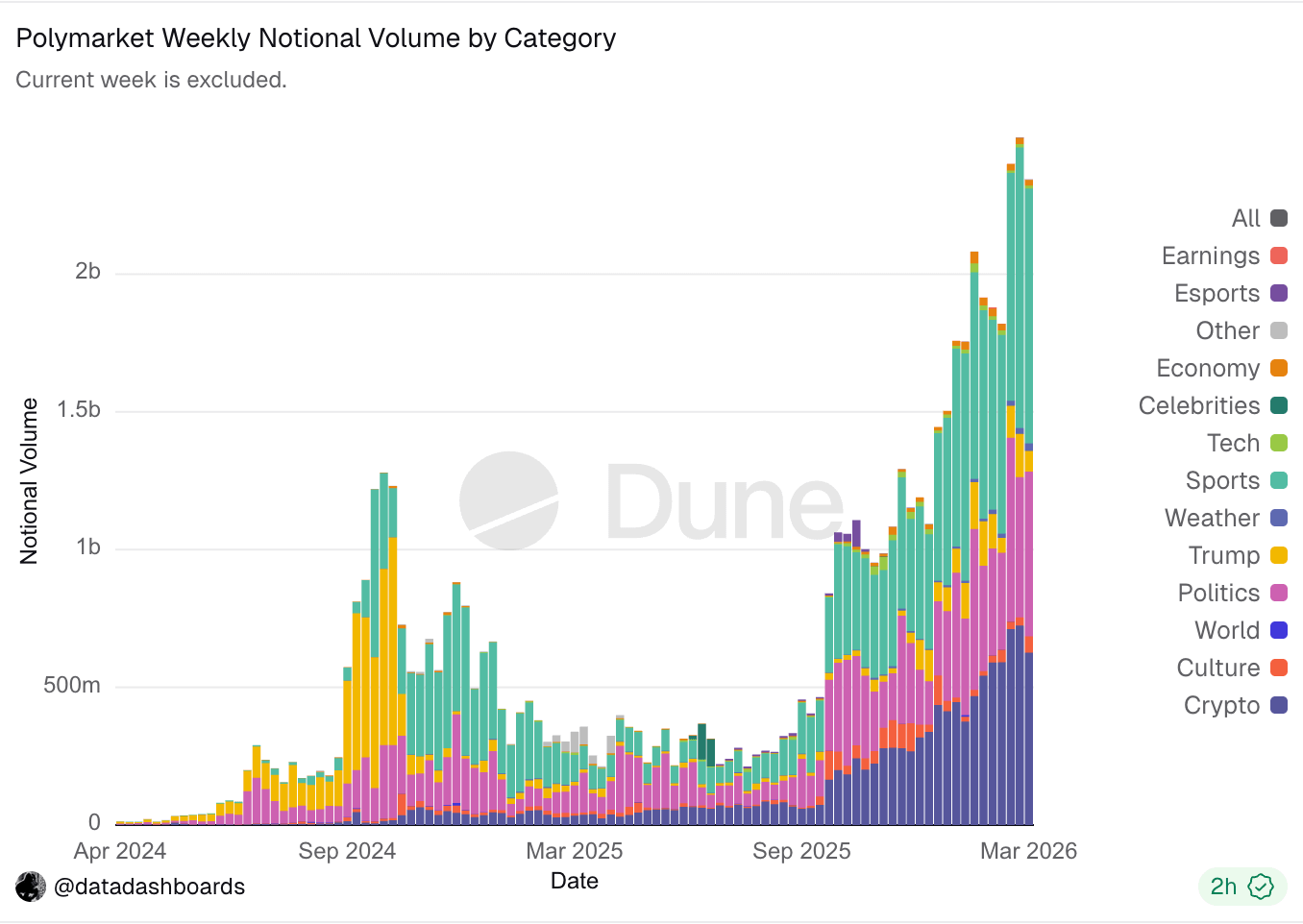
In terms of trading volume, the data dashboard in the image below shows that both the overall weekly trading volume on Polymarket and the cryptocurrency market (the purple bar at the bottom) are continuously growing.
Future revenue forecast
The last time we estimated the revenue for Polymarket, we also needed to manually extract the trading volume ratio of the "15-minute cryptocurrency fluctuations" market among all cryptocurrency-related markets. However, Polymarket has expanded its fee structure to cover all cryptocurrency-related markets since March 6, making the estimation much more convenient this time. As for NCAA and Serie A, perhaps because the former has not yet entered the "March Madness" official phase, and the latter is not highly followed in American culture, the trading volume scale of related markets is significantly smaller compared to cryptocurrency, so we will temporarily ignore them.
Taking the only complete week after March 6 (3.9-3.15), the trading volume of cryptocurrency-related events accounted for 26.7% of the total trading volume on the Polymarket platform for that week, with a fee revenue of approximately $1.84 million—based on this ratio, and under the current trading volume levels and trading structure, if Polymarket introduces similar fee models across all markets, it is expected to bring the platform an annual revenue of $360 million.
The printing machine has started running
It is worth mentioning that as a key measure to expand liquidity, the platform has so far issued a total of $13.41 million in subsidies to liquidity providers (LPs). In comparison, if the data in the remaining days of March can maintain the performance of the first half of the month, the fee revenue for Polymarket this month could cover the total liquidity subsidy expenditures.

Polymarket has basically proven the revenue-generating capabilities of this new form of prediction market. The upcoming revenue growth will mainly depend on two variables—how much more the trading volume can grow and whether the fees can be further expanded to more markets.
If these two variables continue to rise, the prediction market may become the simplest and most direct "printing machine" in the cryptocurrency industry.
Original link