
MakerDAO’s Endgame Tokenomics has been compared to Terra’s seigniorage mechanism, which has caused concern among some investors and analysts.

MakerDAO, the governance token behind DAI, the fourth-largest stablecoin by market cap, has seen a 37% drop in trading volume over the past 24 hours, with the token price down 3.7%.
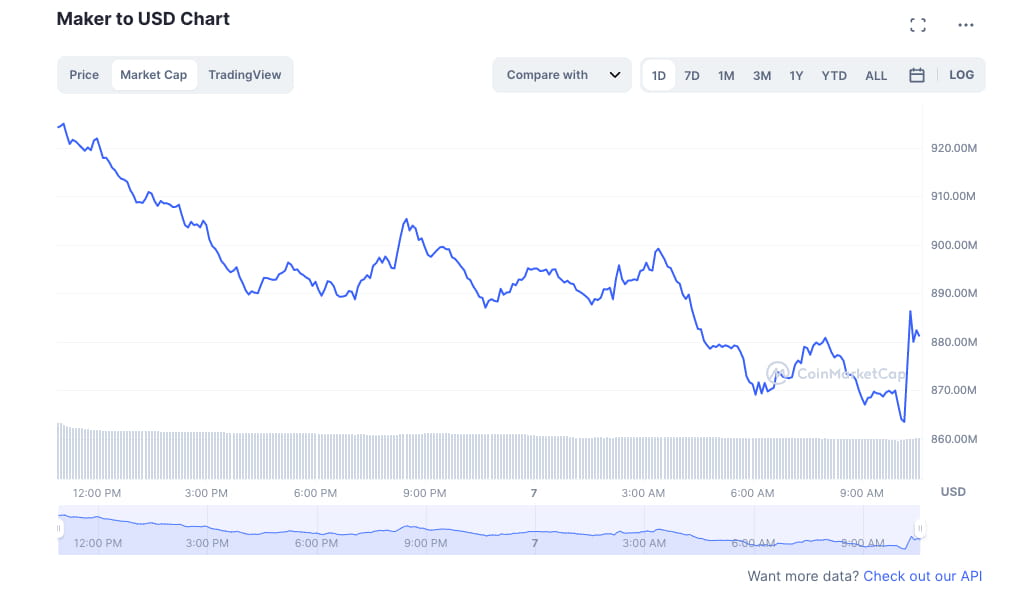
The move follows proposed major changes to Maker’s governance structure.
Following last year’s sanctions on Tornado Cash, MakerDAO co-founder Rune Christensen warned that decentralized stablecoin platforms will face a similar fate.
In Christensen’s view, it was only a matter of time before government authorities targeted MakerDAO. This move prompted the introduction of the Endgame program to strengthen resistance to censorship.
Maker’s Endgame proposal aims to strengthen its decentralized finance (DeFi) platform running on the Ethereum blockchain, allowing users to create and trade stablecoins backed by cryptocurrency collateral and maintained through platform governance and its native token (MKR).
MakerDAO Launches Endgame Token Economics
The new system proposes dividing the DAO into smaller units, called MetaDAOs, each with a different token and goal, while limiting the centralized assets backing DAI to 25% and introducing negative interest rates to reduce liquidation risk.

Criticisms of the Maker Project
However, critics of the plan worry that it will create a potential algorithmic death spiral for DAI, similar to what happened during the Terra/Luna UST debacle.

MakerDAO’s Endgame Tokenomics compared to Terra’s seigniorage mechanism
Similar to MakerDAO’s Endgame Tokenomics, the Terra platform uses a seigniorage mechanism to stabilize the price of its stablecoin. This involves generating and destroying tokens based on market demand, creating new tokens when the value of the stablecoin falls and removing new tokens when it rises.
However, critics were quick to label this mechanism a potential liquidity exit scam, enabling users to leave the ecosystem through DAI without selling their MKR tokens while retaining influence over protocol governance.
Vitalik Buterin chimes in
Ethereum founder Vitalik Buterin has previously expressed concerns that the attack surface of the DAI protocol could expand as more types of collateral are accepted. DAI generation associated with centralized stablecoins such as USDC currently accounts for 56% of all DAI. In addition, real-world assets that are not visible on the chain, such as real estate loans, currently account for 9.6% of all DAI.
Centralization of decentralized governance
Just one MKR wallet holds 12% of all governance tokens, and two unknown wallets hold a combined 44% of voting power. Some have speculated that this dynamic led SEC Chairman Gary Gensler to declare any cryptocurrency other than Bitcoin a security.
Others downplay the risk based on market capitalization differences
The above highlights the challenges and risks of maintaining a stablecoin peg, especially in volatile market conditions.
However, despite the concerns, Frax Finance CEO and founder Sam Kazemian said he is excited to see the outcome of the MakerDAO exit plan.
“The MakerDAO community has been too conservative for their own good. This will be a game changer for the protocol and keep them ahead of the curve. People forget that DAI is no longer backed by USD, so why not make it as efficient as possible?”