

SBT is the abbreviation of SoulBound Token, which means soul bound token in Chinese. It is a form of non-transferable token that is bound to your wallet address or platform account.
The first time I personally came into contact with the implementation use case of SBT soul-bound token was actually when Binance was about to launch BAB (soul-bound token).
对我来说,这是我在行业内相对于其他概念或板块较为陌生的一个名词,我最初知道它是去年一则V神发布在推特的消息,而币安的用例让我对这个概念引起了关注。  (图源:金色财经)
In the process of understanding the content of this concept, I realized that this may be a more reliable solution for on-chain identity. In the current industry landscape where various DAOs are emerging, I think as an industry participant or Investors need to understand this concept.
Today, through this article, I will explain clearly what is a soul token? What are its application scenarios?
1. What is SBT?
01丨Overview
Since the publication of the paper "Decentralized Society: Searching for the Soul of Web3" co-authored by Ethereum co-founder Buterin and two Microsoft researchers in early May last year, the concept of SBT soul-bound tokens has entered the industry. vision.
The issue of identity verification has always been a problem that the crypto-blockchain industry has been grappling with. From the KYC of centralized institutions to the concept of decentralized form of DID, to the SBT soul-bound token, everything has always revolved around identity verifiability and We are making breakthroughs on the issue of uniqueness.
Different from DID, SBT's goal is to establish a bottom-up credit system, not just an identity certificate on the chain. The credit system is a crucial part of the system in the real world. The personal loans we often use, such as Huabei and other financial lending tools, are based on the credit scoring system.
In the crypto-financial landscape, due to the imperfect credit system, lending and other ecosystems are usually dominated by asset mortgages, and the emergence of SBT is expected to allow personal credit to be truly built on the chain, thereby deriving on-chain Unsecured credit products.
02丨Concept details
The soul in the soul token binding refers to the pronouns of various personal addresses and accounts on the chain, representing an individual's different identities on the chain. An individual can have multiple "souls", corresponding to SBT under different systems, which can be domain names, DAO identities, platform addresses, etc.
Although the domain name is currently used as an identity certificate, it is different from the domain name in that SBT is a collection of identities, while the domain name can usually only integrate some wallet addresses;
After understanding "soul", the soul-bound token (SBT) is easy to understand: in terms of expression, it is a token certificate issued and bound to your different identities on the chain, reflecting the An “on-chain resume” of identity.
This information is saved on the chain in the form of images or encrypted information and updated based on your on-chain behavior. Ideally, the updates here are notarizable and cannot be forged.
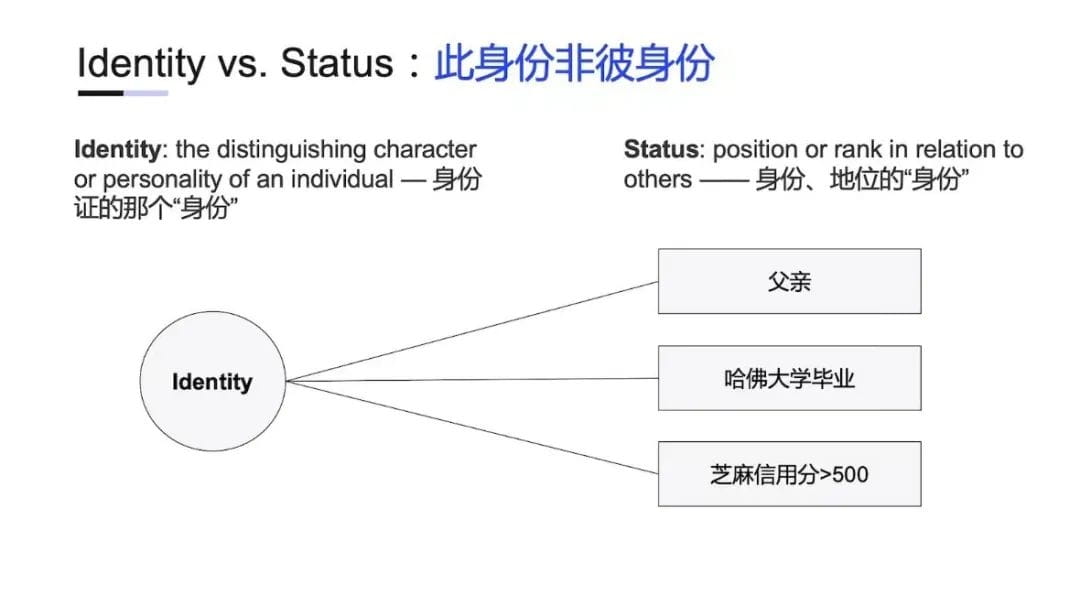 (图源:《去中心化社会:寻找Web3的灵魂》)
In an ideal application scenario, any online or offline institutional group or individual can issue SBT to a wallet, such as the company you work for, the various on-chain DAOs you participate in, and the school you graduated from, etc., and you can receive it in a wallet. to a variety of SBTs from different subjects and individuals.
As a non-transferable token, when your wallet receives it for the first time, this SBT is equivalent to your label and will always be placed in your wallet. However, in this setting, reception should be selective, otherwise tools need to be derived to prevent malicious SBT attacks (that is, individuals maliciously send SBT to addresses).
2. Application scenarios of SBT
The application of SBT will make the Web3 world richer. Similar to the establishment of a credit system, it will not only improve use cases in the financial field, such as on-chain credit applications, but also reduce the number of criminal incidents on the chain. A complete on-chain identity system can also allow sectors such as chain games to effectively interact with the real economy. In terms of on-chain governance identity, it can also give the original DID concept a broader space for imagination.
In addition, SBT still has the following use cases to be explored:
1. Proof of Identity (DID) Soul Binding🔐
The use of proof of identity (DID) allows participants to have an identity verification system in the construction of DAO to maintain the security and access mechanism of DAO. However, this form of DID has tradable attributes and is not identifiable, and some OTC investments Investors will be able to purchase these NFTs at relatively low prices to join a DAO, which will lower the entry threshold for some DAOs;
After being bound to SBT, the attached reputation system will make this identity information non-transferable. Even if the identity credentials are transferred, new holders can have a more intuitive visualization of their contribution value. .

2. Ensure the fairness of airdrops⚖️
Friends who have participated in on-chain airdrop activities must be aware that the current mainstream airdrop method is to use an open permission whitelist to prevent a single user with multiple addresses from maliciously obtaining airdrop rewards;
The airdrop method of binding BFT to addresses can greatly curb the behavior of multiple addresses. The real experience and identity verification of a single address help the project team accurately issue airdrops and match real and effective early users more efficiently. .
3.Wallet recovery🔑
I think the loss of private keys is a huge headache for blockchain. In the traditional Internet, users can retrieve their passwords by verifying their true identity. Similarly, SBT is an identity reputation system. It can also reset or reproduce the mnemonic phrase based on this principle to ensure the security of assets and reduce the risk at the same time. Risk of loss.
4. “Bad reviews” on the chain😈
The implementation form of SBT can also be an on-chain evaluation system, which is similar to the evaluation of merchants by customers in the real world. By binding "bad reviews SBT" to some evil users on the chain, it will be able to greatly curb some on-chain evil behavior;
But this use case needs to consider the reverse malicious "bad review", that is, maliciously sending this kind of SBT to an address that has no malicious behavior. Therefore, this use case should be issued by some authoritative organizations or become a negotiable and uploadable proof of SBT issuance method.
5. Off-chain identity authentication🙌
The use of SBT will allow some celebrities in the real world to verify the authenticity of their identities when conducting on-chain activities to ensure the reliability of on-chain actions.
The most widespread use case should be some well-known artists or stars in the real world to issue NFT activity certificates on the chain. As an issuer or authorizer, due to the gap between reality and virtuality, there is no set of identity verification to be verified. The system will cause some malicious hype behaviors to be abused, and SBT can curb this behavior.
The use cases listed above are only part of the applicable scope of SBT, and wider adoption still awaits the development of the industry. SBT also needs to be realistic. On the premise of considering the KYC plan of professional institutions and the decentralized DID plan, how to combine it with compliance is believed to be one of the biggest obstacles encountered in actual progress.
As a relatively new concept, there are still some existing problems that need to be solved in the area of identity verification or credit systems~
3. Development obstacles
Although the technical implementation of SBT is still in an extremely early stage, and the technical implementation methods have not yet been accurately implemented, there are still problems that need to be solved. From my personal point of view, this seems to have always been the case. is the drawback of the crypto industry.
The process of technology implementation is constantly updated and explored in the process of clumsiness to perfection. From the early public chains to the various high-performance public chains now, the same logic is used, and it is no different here at SBT.
At present, the more intuitive development obstacles include the following:
1.SBT malicious attack⚠️
I think this is an obvious problem at the stage of proposing this concept. Since it is a non-transferable form of token, how to protect normal addresses from malicious SBT token binding attacks is a technical problem that remains to be solved.
2. Non-transferable potential risks ⚠️
This problem is somewhat similar to the "private key cannot be retrieved" problem, which is an opposite problem in the form of technology. Because the algorithms between chains are incompatible, a user usually has multiple wallets to store assets, which is a very common phenomenon;
The non-transferable mechanism of SBT will allow some wallets in risky environments to be exploited by hackers due to binding, thereby sneaking into relevant social channels to publish information that is detrimental to the original holder, such as SBT certificates issued by DAO. In the case of accidental loss of a wallet, it is still difficult to prove whether the owner is still the same person.
3. Issues of privacy disclosure⚠️
For the "soul information" bound to the public SBT, since on the public platform, the information will be public by default to a large extent, and an address may hold multiple SBTs, it may be that the information held by multiple SBTs is public. The information provided is concatenated to derive a real-life identity;
This undoubtedly brings trouble to some users involved in the encryption world. After all, they may have been in the encryption industry for privacy from the beginning. In order to achieve this kind of privacy protection on demand, it may be necessary to derive or use some existing privacy protection technologies in combination with each other, which is quite comical as the expansion demand derived from meeting Ether performance.
4. Deletion of information⚠️
If SBT is used in social scenarios, it will inevitably involve the issue of modifying the user's personal information. Whether to overwrite the old data with new data or to modify the original data, modification is relatively complicated for the blockchain. things.
5.Data source problem⚠️
This problem also applies to the oracle track. How to set up appropriate incentives to make traditional institutions willing to link up is still a difficulty. How to make them accept encrypted payment methods is a major obstacle between most traditional institutions and encryption. a sky tower;
At the same time, since there is a data source, there is also a privacy paradox. That is to say, personal information is stored in the hands of a third party off-chain, but if it is uploaded independently, it also involves the problem of information fraud.
Apart from the above known problems, SBT does not have overwhelming support in the industry. Many voices pointed out that the current infrastructure of the blockchain cannot support the establishment of the overall framework of SBT. Based on the underlying technical genes, it is difficult for SBT to reflect its true value.
A tall building begins with a foundation stone. This is an everlasting truth. Encryption currently relies on the upgrading and exploration of underlying technology based on underlying facilities. Until a platform emerges that can meet the needs of both users and developers, it will still be unable to achieve a qualitative leap in the industry.
4. Current situation and future
To sum up, as a new concept of identity protocol, the implementation of SBF basically relies on the interaction between the chain and the off-chain. Any part involving the off-chain is more difficult in the encryption industry.
The encryption industry has always been unstable, especially after last year’s LUNA and FTX incidents, which made this inherent impression even more ingrained;
In the industry, compared to the existing Web3 identity protocol, SBF’s credit system, wallet recovery and use cases for reducing on-chain evil behavior are undoubtedly more comprehensive and positive for the industry, but will it be compared with some previously established identities? It remains to be considered whether the protocol or DID concepts create logical conflicts.
The large-scale implementation of SBT first involves incentives for traditional off-chain data sources and some on-chain storage, privacy and security issues. In the future, SBT may coexist with a variety of solutions, but in the sector structure, I judge that it may form a near-monopoly structure like an oracle, that is, the entire industry only uses one solution for almost 90% of the time. A general solution.
Of course, the SBT concept is not yet mature. Under the current infrastructure and supervision of traditional fields, the incremental development of users in the industry is hindered. In the situation of technological involution, SBT may only remain a concept or a hype among existing users in the next few years.
What do you think about SBT? 😁