

Written by: Chris Powers
Compiled by: TechFlow
It’s time for the annual year-end summary (which is also a good time to look back at our popular memes in 2021 and 2020). Despite the market downturn in 2022, DeFi remains a strong field, embraced by projects large and small. It remains a compelling symbol for a transparent, global, and digital financial system.
Unfortunately, the state of cryptocurrency memes is very bad in the eyes of ordinary people. It is difficult for DeFi to develop when any cryptocurrency is labeled as a scam. However, this will pass soon. In the meantime, there is still a lot of work to be done to move DeFi forward, from infrastructure to application layer to basic market structure.
All in all, 2022 could be the year that DeFi regulatory conversations — especially around stablecoins — get more serious.
1. Market crash
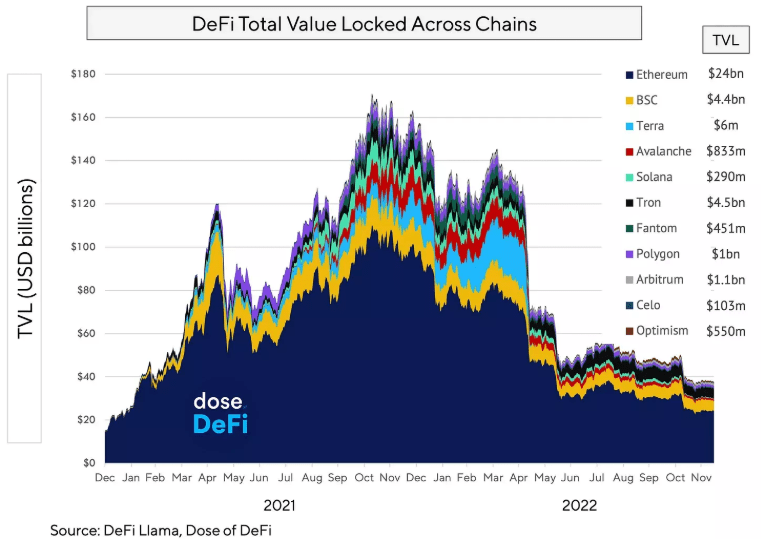
Almost every crypto asset and DeFi metric has been in free fall in 2022. This has been exacerbated by two major implosions: first the decline of the Luna and Terra stablecoins, and then just last month, the massive fraud at FTX.
However, none of this strikes at the core of DeFi. FTX’s bankruptcy actually makes a stronger case for non-custodial exchanges and transparent loan books. And Terra’s failure shows that algorithmic perpetual motion machines are a fantasy.
An overlooked claim is that the market crash did not cause DeFi protocols to fail.
In fact, compared to March 2020 and Black Thursday, DeFi has performed perfectly.
Still, the massive drop in ETH and huge stablecoin outflows have significantly reduced DeFi’s TVL and revenue-generating power. This has slowed investment in the space. However, this could be a healthy development by encouraging longer-term building rather than trying to rush out products and ideas before the noise dies down.
2. Regulation
In a year filled with regulatory scrutiny, Elizabeth Warren just passed a blockbuster piece of legislation this week. The proposed bill is a full-on assault — KYC checks on all wallets and literally slapping node operators — and while the odds of it passing are slim, this seems to be indicative of a theme across all the proposed regulatory changes. We admit that we were a little naive in our belief that crypto’s appeal to authorities would translate into legislation. What has really happened this year is that regulators have become more aware of the DeFi and crypto ecosystem in and out.
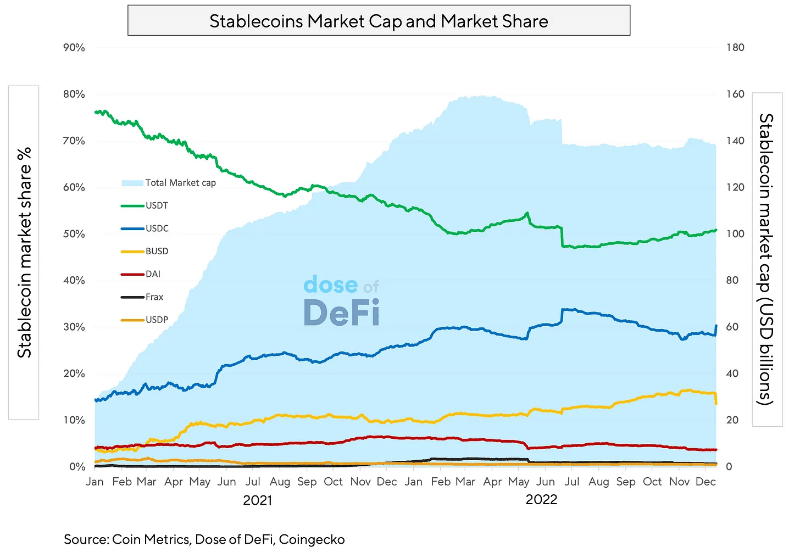
Nowhere is this more true than with stablecoins. Large centralized banks (Tether, USDC, and BUSD) have become so large that they are now considered shadow banks, which pose a potential systemic risk to the global financial system.
Meanwhile, the collapse of stablecoin Terra makes us wonder whether regulators will put greater scrutiny on anything claiming to be pegged to $1. For the industry, this means stunted growth and a shift in liquidity toward “safer” centralized stablecoins like USDC and BUSD instead of Tether. Still, the long-term momentum for stablecoins is strong.
3. Cosmos, Lisk, and modular blockchains enter the DeFi space
At first, DeFi ran only on the Ethereum mainnet, before expanding to other EVM-compatible chains, including Layer 2, in 2020 and 2021. This lowered costs for users but had the same composable market structure as the Ethereum mainnet. In 2022, as DeFi progressed and bottlenecks were resolved, the industry began to explore entirely new infrastructure. Cosmos has been around for years, yet it wasn’t until 2022 that it finally built out an ecosystem of wallets, blockchain explorers, and DEXs that offer an experience comparable to established blockchains. As we explored in our April Cosmos deep dive, its defining feature is its ability to connect disparate blockchain networks. This is a feature built into the network itself. Projects to watch next year: Agoric (supports smart contracts written in JavaScript) and Archway (distributes incentives to developers directly from smart contracts).
dYdX, one of the oldest DeFi projects, joined Cosmos this year and launched its own chain. It now offers free trades for unexecuted orders and has optimized its validators to store order books. dYdX is arguably the first successful application chain, a competing vision to the EVM model centered on composability. Now, many suggest that all major DeFi protocols, such as Uniswap, launch their own application chains.
This vision has been further developed with the rise of modular blockchain designs. This vision has not yet been realized, but it has received a lot of attention in 2022. Celestia and Polygon Avail are two new blockchains that solve the data availability problem by using modular blockchain architecture. Unlike existing blockchains, these networks do not verify transactions, but instead focus on ensuring that new blocks are added to the network through consensus and provided to all nodes. Celestia’s first partners demonstrated potential use cases: dYmension (allowing rollups to issue tokens and choose a data availability layer), AltLayer (high-throughput “one-time” rollups where NFTs are generated and then bridged to L1), and Eclipse (rollups using Solana VM and the IBC protocol).
4. Consolidation of MEV’s position
In 2022, MEV has professionalized. Yes, there are still anonymous developers in the dark forest, but it is now seen as a playground for the world's most sophisticated traders. Flashbots, the protagonists in MEV, have become more successful in 2022 with the transition to PoS (nearly 90% of Ethereum validators are running MEV-boost). However, with this success, people also realize the centralization and censorship threats brought by this market design.
The status quo of Flashbots as trusted intermediaries is unsustainable. As we investigated in last week’s deep dive, it is clear that the MEV space will move off Ethereum onto a separate network that can balance the benefits of MEV profit extraction with the need to democratize and decentralize this market.
Flashbots’ answer is SUAVE, a brand new blockchain for building blocks on any chain. It’s ambitious, but not dissimilar to extracting MEV from CoW protocols through batch auction restrictions, or Chainlink’s fair ordering service. All of them recognize that transaction ordering is critical to ensuring that blockchains maintain their credible neutrality and limit rent extraction.
5. Where are the new DeFi applications?
Dose of DeFi launched in June 2019, as people and projects were gathering under the DeFi banner. 2020 saw proof of concept for the core. 2021 and 2022 saw an influx of new projects and funding into the space, but as we said in our March “Has DeFi Innovation Stalled?”
Indeed, it’s hard to find any major DeFi innovations in 2021 that compare to the likes of Uniswap (November 2018), Synthetix (January 2019), MakerDAO Multi-Collateral Dai (November 2019), Curve (January 2020), COMP yield farms (June 2020), and YFI governance allocations (July 2020).
It now seems that the most important and promising DeFi projects were almost all launched more than two years ago.
This view, while not entirely accurate, focuses entirely on the application layer, or the end-user experience. In our view, this understates DeFi because it frames it as fintech, which is simply a modern application wrapper for traditional financial systems.
DeFi is bigger than the application layer. DeFi also includes an infrastructure layer and a market structure layer. In these areas, there has been a lot of progress in 2022.
Current DeFi applications are built on the infrastructure and market structure of cryptocurrencies in 2018.
While the entire industry is researching and building the next generation of DeFi infrastructure and market structure in 2022, more progress is needed before innovation returns to the application layer.

