


In the world of cryptocurrency, few controversies have sparked as much intrigue as the "Howey memo." This confidential document, handed over to former SEC officials William Hinman and Jay Clayton in 2018, has remained shrouded in secrecy, leaving the crypto community in suspense. Recently, XRP lawyer John Deaton has ignited a new wave of curiosity by raising questions about the memo's undisclosed status and its potential implications for Ripple's XRP. In this blog post, we delve into the mystery of the Howey memo, exploring Deaton's claims and the implications they could have for the future of XRP.
Unlocking the Howey Memo:
John E. Deaton, a prominent figure in the crypto community, has cast a spotlight on the elusive Howey memo. This confidential note, received by Hinman and Clayton prior to the Hinman speech, has long been a subject of speculation. However, Deaton's recent revelations have given the crypto world much to ponder.
Deaton's Intriguing Claims:
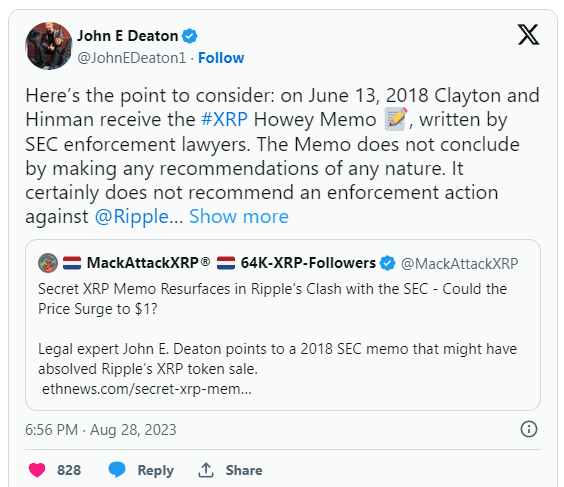
On August 28, 2023, Deaton took to Twitter to share his insights into the Howey memo's potential contents. His most striking assertion was that the memo might have characterized XRP as a non-security. This claim raised eyebrows and led many to wonder about the true nature of the document.
In a video that sent ripples through the crypto community, Deaton suggested that the Howey memo's undisclosed status might be linked to its contents. He posited that if the memo had unequivocally labeled XRP as a security, there would be no reason for it to remain hidden from the public eye. Deaton posed a critical question: "How come the Howey memo isn't an exhibit? How come Jay Clayton and William Hinman didn't say XRP sale was clearly a security? Because at best the memo said XRP was given away by Ripple for a non-investment purpose."
Timing and Meetings:
One crucial aspect of Deaton's claims is the timeline. The Howey memo was presented to Hinman two months before his influential Hinman speech, providing ample time for its examination and consideration. Deaton also highlighted a significant meeting between Ripple CEO Brad Garlinghouse and SEC officials. If the memo indeed classified XRP as a security, one would expect the SEC officials to confirm this during their discussions with Garlinghouse. However, Clayton's response to Garlinghouse was far from conclusive, leaving room for further speculation.
The Omission of XRP:
Another curious aspect noted by Deaton was William Hinman's omission of XRP in his speech, despite acknowledging bitcoin and ether as non-securities. XRP, as a major rival to ether at the time, stood out by its absence in Hinman's remarks, fueling suspicions that the Howey memo may have played a role in this omission.
Conclusion:
John E. Deaton's thought-provoking questions surrounding the Howey memo have added a new layer of complexity to the ongoing XRP saga. As the crypto community eagerly awaits further developments and possible disclosures, one thing remains clear: the Howey memo's secrets hold the potential to reshape the narrative surrounding XRP and its regulatory status. Stay tuned for what may be the most significant revelation in the world of cryptocurrency.