


Written by: BiB Exchange
introduction
I believe everyone is familiar with the topic of DePin. At present, there are different opinions on the DePin track in the market, but due to Filecoin, some opinions are inevitably biased and narrow.
First, Juan Benet Protocol Labs of Filecoin, the project party, sneered at investors, especially those in Chinese-speaking regions who only wanted to make money by mining crazily, which was not beneficial to the ecosystem. He believed that IPFS had so many applications, whether it was NFT storage on the chain, storage of front-end and back-end resources of distributed applications (DApps), DID, metaverse, game assets, virtual reality content storage, or offline scientific research institutions, schools, museums, hospitals, banks, personal archives, etc., thousands of industries have already realized distributed storage. However, Filecoin has been controlled by some large miners, that is, head investors. This has led to most retail investors in the market losing a lot of money because of the pledged coins and mining machines they bought at $200. But even if investors and the project itself are in a state of mutual dislike, they have to put down their airs and sit together to discuss various applications and developments such as DC, FVM, and CDN.
DEPIN is a decentralized network that integrates multiple resources such as computers, bandwidth, storage, and memory. Unlike traditional blockchain networks, DEPIN focuses on building decentralized physical infrastructure to provide support for more application scenarios. Miners have set their sights on DEPIN as the direction of the next layout because it represents the next important evolutionary step of the future Internet. In the DEPIN network, miners can participate in mining by contributing computer bandwidth, storage, memory and other resources to obtain corresponding token rewards. This mining model based on actual physical resources makes DEPIN a more robust and sustainable decentralized network. At the same time, the development of DEPIN also helps to build a more powerful and secure decentralized application ecosystem. In any case, IPFS is indeed presented to everyone as a typical example of the DePin track.
In this article, BiB Exchange will lead everyone to explore the development of the DePin track and its future trends starting from FIL.

1. DePin Background
1.1 Bull Market Engine
The bull market in 2021 has enabled many miners and digital asset investors to achieve considerable returns, and these successful people have also started a new round of layout during the subsequent market interval. The seeds of this bull market have begun to germinate from 2019 to 2020, and many mining coin owners have begun to quickly deploy various digital assets to prepare for future market fluctuations. Similarly, the bull market atmosphere in 2024 is also quietly brewing. This time, they will focus on a more cutting-edge field-Decentralized Physical Infrastructure Networks (DEPIN for short).
History always repeats itself. The BiB Exchange team believes that by building a large number of IOT facilities, more people can be encouraged to participate. Therefore, DePin may also become the engine of this bull market.
1.2 Institutional support
In mid-2023, we discovered that Wanxiang Blockchain Lab and HashKey Capital announced the joint launch of the Web3.0 innovation incubation platform Future 3 Campus, focusing on the three major tracks of Web3.0 Massive Adoption, DePIN, and AI.

Binance Labs expects 2024 to be an upward year amid challenges, and judges that the main narrative will revolve around two areas. The mainstream view is that the biggest challenge in 2024 is that the speed of technological change may be slower than the speed of the industry's transition from a bear market to a bull market. To put it simply, the development of infrastructure cannot keep up with the speed at which users and funds flow into the industry.
Fundamental Labs and Magnus Capital show that they are more concerned about DePIN, the integration of AI and Web3, and the infrastructure of the Bitcoin ecosystem. This actually coincides with Hashkey's strategy, which shows that most investment institutions are very eager to pay attention to the DePin track. Investor Ken also agrees that the industry will focus on the combination of DePIN, AI and Web3, and points out that the lack of large-scale and high-security interoperability is still a challenge, and it is expected that zk technology will further mature and improve this demand.
1.3 Seamless connection between Web3 and Web2
Seamless interoperability DEPIN is designed with an emphasis on interoperability. Through open standards and protocols, Web3 can be seamlessly connected with existing Web2 applications. This interoperability helps achieve a smooth transition, allowing users to enjoy similar service experiences in different network environments. This is especially true for the smooth migration of Gamefi/Socialfi to Web3. DEPIN provides a more stable infrastructure for Web3 and supports the rapid development of distributed applications.
At the same time, not only is there seamless migration in the Web2 field, but even in the current Web3 field, decentralized finance (DeFi), a key project, is constantly expanding. DEPIN provides more powerful infrastructure support for decentralized finance, including more reliable data storage, computing resources, etc. This will help promote the development of DeFi applications in Web3 and achieve interoperability with traditional financial systems.
1.4 AI has a large mass base background
DEPIN incorporates physical infrastructure into the decentralized network, allowing Web3 to connect more directly with actual hardware resources. The BiB Exchange team analyzed that this connection method not only improves the stability of the network, but also supports more application scenarios, such as the Internet of Things and edge computing. Many projects are funds bound to personal computers. In name, they are AI, but in fact they use the computing power of personal computers for mining, attracting a large number of users.
For example, Binance invested in AI computing power mining project QnA3AI, which faces this challenge through Web3 information and the world's one-click gateway. QnA3.AI not only provides information access; it also provides complex logical analysis functions, allowing users to not only collect data, but also effectively understand and interpret data. In QnA3's knowledge graph, there is a large amount of structured data, which enables AI to give more accurate and convincing answers.

This type of project also includes: Adot, Arkham Intelligence, Clab.ai, ChainGPT, Kaito, Perplexity, Polygon Copilot, TypoGraphy AI and other 8 other Chat-based generative AI product projects, also based on opBNB, and Carv, a US game chain data infrastructure company founded in 2021. Their goal is to build a platform that displays users' game identities and achievements and tokenize them. Users are also required to bind data from wallets, emails, Twitter, Discord, TG and other platforms. It also uses data from major client platforms for mining, which is theoretically also a mining behavior.

Noscription
NoScription is Nostr's first inscription protocol, which uses a mining method based on Nostr NIP13 PoW. Nostr inscription is to sign a text message in JSON format, and the ownership of the inscription is obtained after the signature is completed.
The Nostr protocol adopted by NoScription is an open source social network protocol consisting of multiple clients and relays. Relay is the server node of the Nostr protocol, responsible for receiving, storing and forwarding user messages. The data in the Nostr protocol is not recorded on the blockchain, but transmitted through relays. As a decentralized physical infrastructure, the DEPIN network provides stronger support for the Nostr protocol.
However, the community has questioned NoScription's mining mechanism, believing that its essence is to consume users' computing power for mining, and generally feels that mining is difficult. Some users said that their computers were smoking and accused NoScription of stealing computing power. But in general, NoScription, as an inscription protocol project based on the Nostr protocol and the DEPIN network, aims to achieve the development of Web3 and provides a new mining mechanism.
2. Macro Overview
First, let’s take a look at the top projects in the DePin track by market value on CoinMarketCap:

2.1 Traditional decentralized cloud
IDC released the "Global Semi-annual Public Cloud Services Tracking Report", and the global cloud computing market grew by 22.9% year-on-year in 2022, with total revenue exceeding US$540 billion. According to data released by IDC, the largest single spending area in 2022 is SaaS applications, with global annual revenue of US$246.3 billion, followed by IaaS, with global annual revenue of US$115.5 billion.
From the perspective of the global public cloud structure, IaaS is the fastest growing market segment, and SaaS is the largest market segment. AWS and Azure are advancing in parallel. Microsoft is the world's largest public cloud provider, accounting for 16.8% of the entire market, followed by AWS, accounting for 13.5%. Salesforce, Google and Oracle are ranked in the top five. It can be seen that the charges for centralized clouds are quite expensive.
The difference between traditional centralized cloud and decentralized cloud: Distributed storage system is to store data in multiple independent devices. Traditional network storage system uses centralized storage server to store all data. Storage server becomes the bottleneck of system performance and the focus of reliability and security, which cannot meet the needs of large-scale storage applications. Distributed network storage system adopts scalable system structure, uses multiple storage servers to share storage load, and uses location server to locate storage information. It not only improves the reliability, availability and access efficiency of the system, but also is easy to expand.
Of course, the most embarrassing feature of traditional centralized cloud is that it is usually very expensive.

The global datasphere is expected to grow at a compound annual growth rate of 58% from 2015 to 2025, with more than 180ZB of data being created, stored, and replicated by 2025. If you were to stack enough 10 TB hard drives to meet the world’s data needs by 2025, the stack would literally reach the moon. If all of them were to use traditional centralized clouds, many companies and institutions would need to pay extremely expensive prices.
Therefore, traditional centralized clouds are more expensive, and this is where DePin comes in.
For example, the IPFS distributed storage that we have been criticizing before, this protocol is to distribute PB-level big data, how to process high-definition media streaming data, how to modify and iterate large-scale data, how to avoid accidental loss of important files, etc. These are all major challenges that hinder the continued development of HTTP. The average life cycle of current web pages is only 100 days, and a large amount of Internet data is deleted every day. The data on the Internet is a record and display of human civilization, and IPFS provides a way to make Internet data.
The technical foundation of IPFS includes distributed hash table (DHT), block exchange protocol (BitTorrent), version control (Git), self-verifying file system (SFS), Merkle DAG and Merkle Tree. All these technologies are what traditional centralized clouds need to catch up with and continue to evolve.
At the same time, because the technical mechanism of IPFS includes PoS (Proof-of-Storage), PDP (Provable Data Possession), PoRet (Proof-of-Retrievability), PoRep (Proof-of-Replication), PoSpace (Proof-of-Space), PoSt (Proof-of-Spacetime); PoRep and PoSt are two instances of PoSpace, and their definitions overlap. The implementation of Proof-of-Replication and Proof-of-Spacetime determines the configuration of the Filecoin server. It indirectly determines the overall cost of the Filecoin system. Filecoin provides two services: storage and data download services. The system cost ultimately determines the user's usage cost and also determines the advantages of decentralized cloud.
In addition to Filecoin, there are some other similar decentralized cloud storage and file sharing blockchain projects:
Storj: is a blockchain-based decentralized cloud storage platform that allows users to rent out their hard drive space and ensures security by encrypting and decentralizing data storage.
Sia: It is also a decentralized cloud storage platform that uses blockchain technology to create a distributed storage network.
AR: It is a permanent storage network that uses blockchain technology to achieve decentralized and tamper-proof data storage.
Bluzelle: is a distributed database service that uses blockchain technology to provide decentralized database solutions.
2.2 DePIN leads a new wave: Helium Mobile
So what are the projects that are returning to the new round of enthusiasm? The areas that institutions have focused on recently can be divided into two categories: infrastructure and application. Especially the hot spots that combine the two. There are two main reasons: the first is to follow the industry development cycle, and the second is to prepare for the new narrative of Web3.
The core concept of DePin is to use tokens to motivate users to deploy hardware devices to provide real-world goods and services or digital resources. DePIN can be understood as two parts: physical resource networks and digital resource networks. Physical Resource Networks (PRN) means that users use hardware distributed in various places to provide WiFi, 5G and VPN. Geospatial data, information sharing and other services; Digital Resource Networks (DRN) means the physical infrastructure network that provides digital resources through hardware facilities, including broadband networks, storage networks and computing power networks.
With the development of blockchain technology, the infrastructure track has become a hot focus in the cryptocurrency market. Among them, Helium Mobile, as a representative of the DePIN track, has attracted widespread market attention. Helium Mobile has emerged in the market with its advanced blockchain technology and unique DePIN track.

Helium is a centralized wireless network project, whose token is HNT, which is used to pay for network data transmission. Helium combines Web3 technology with IoT networks to solve the problem of high capital threshold in the IOT network market (mobile operators such as China Mobile and China Unicom), and aims to improve the pain point of WI-FI and centralized operators' inability to efficiently cover the signals in the middle area by expanding 5G (essentially LoRaWAN replacing 2G network) network business.

However, what is criticized is that the project was originally launched from the perspective of selling mining machines, and it was operated exclusively (including routers, power supply, and Wi-Fi or Ethernet port connection). However, this project has received funding from Google Ventures, USV, Multicoin, Tiger Global, etc. After raising nearly $110 million in August 2021, it completed another $200 million in financing in March 2022. At the same time, after Helium migrated to Solana in April 2023, LoRaWAN hotspots no longer generate HNT, but IOT.
2.3 Regional data on-chain Hivemappe & DIMO
Hivemapper is a blockchain-based map network project that aims to create global maps in a decentralized way and incentivize contributors through cryptocurrency. It creates a decentralized global map that rewards contributors. Contributors can collect data by installing Hivemapper's dashcam and earn HONEY as a reward. In Hivemapper's setting, dashcams are equivalent to "mining machines".

Hivemapper adopts a decentralized approach, so that the collection and maintenance of map data is no longer monopolized by a few leading companies. Data collection can be carried out by contributors installing Hivemapper dashcams. In the setting of Hivemapper, dashcams are equivalent to mining machines. By integrating with the Hivemapper network, data collected during driving is automatically uploaded. At the same time, local HONEY is obtained as a reward. Currently, there is a huge bonus reward system in 35 selected cities, giving these places a higher reward weight.
Of course, there is another project similar to Hivemapper, DIMO. Similarly, Dimo is an automotive IoT platform built on Polygon, enabling drivers to collect and share their vehicle data. It belongs to the Drive to Earn track and is one of Hivemapper's competitors.

However, the two have different focuses. Hivemapper is a blockchain-based map network that encourages anyone to collect map data extensively by driving a car. DIMO connects cars and drivers themselves and monetizes driving data, depending on the effective use time of the product by the owner and the connectivity of the device.

2.4 Bittensor at the AI level
Bittensor is an open source protocol that aims to build decentralized, scalable neural internet solutions, focusing on artificial intelligence and machine learning. This means that its code and design solutions are publicly available. This encourages community participation and contributions, helping to drive the development and improvement of the protocol. One of Bittensor's core concepts is to promote information sharing through collaborative practice of machine learning models. By rewarding models for their contribution to the overall information, Bittensor attempts to build an open and transparent AI market that encourages cooperation and learning between models.

Bittensor aims to break down AI information silos and build a decentralized neural internet solution. This means it aims to enable broader information sharing and collaboration by allowing Bittensor models to learn data and transfer value with other AI models.
Bittensor's first product is Chattensor, an AI chat assistant robot. As a practical application of the Bittensor protocol, Chattensor demonstrates how the protocol supports machine learning and AI applications. This shows that Bittensor is not just a theoretical framework, but can also demonstrate its potential uses through practical applications.
TAO is the token of the Bittensor protocol, with a total supply of 21,000,000, and adopts a token economics model similar to Bitcoin (BTC). It uses the Proof of Intelligence consensus mechanism to provide security and stability for the Bittensor network. In addition, the TAO token also adopts a halving cycle, which is expected to be completed around 2213. As of 15:00 Singapore time (UTC+8) on January 14, 2023, its price has reached US$230.
2.5 EVM-compatible public chain IOTX
IOTX (IoTeX) is an Ethereum Virtual Machine (EVM) compatible public chain project established in 2022. The goal of the project is to build a trusted IoT ecosystem with a privacy-centric, high-performance blockchain platform.

www.bibvip.com
As a Silicon Valley open source project, IOTX is committed to building a trusted computing and application platform by integrating blockchain, trusted hardware and edge computing technologies. The core concept of this platform is to provide a decentralized DApp Internet, smart facilities, services and digital assets for the Internet of Things, thereby providing higher value to users.
IOTX combines blockchain, trusted hardware, and edge computing to provide high performance and privacy protection. Through the fusion of these technologies, IOTX provides a trusted infrastructure for the IoT ecosystem, supporting applications including Cyclone, Mimo, UCam, Pebble, ioPay, and ioTube.
IOTX focuses on data security and user privacy, and ensures the secure transmission and storage of data through blockchain technology. This feature provides support for secure interaction between IoT devices and is an important aspect of promoting the progress of trusted IoT. IOTX's goal is to shape a trusted IoT ecosystem that connects the world through blockchain technology. The ecosystem includes decentralized DApp Internet, smart facilities, services, and digital assets, providing users with diverse value.
At the same time, as an Internet-oriented public chain project, it integrates a variety of advanced technologies. IOTX has launched the DePIN liquidity center, which includes many projects such as GEODNET, DIMO, XNET, Drop Wireless, WiFi Map, Wicrypt, etc. This liquidity center has broadened the scope of the IOTX ecosystem and improved its position in the DePIN field by promoting cooperation in technology, funds and resources.
2.6 Global Network WiFi Map&ICE NET
The WiFi Map project is centered on a mobile app, which includes eSIM, offline maps, WiFi finder, VPN, and wallet. WiFi Map allows the community to provide their own restricted WiFi hotspots to participate in the WiFi Map project, and receive token WiFi rewards based on the corresponding indicators. Users can purchase WiFi tokens for the corresponding Internet services it provides, or participate in related market transactions and other activities.
Another project, ICE NET, is a decentralized Internet privacy infrastructure based on zero-sense proofs, which aims to provide a reliable and efficient privacy-protecting Internet system for all users. ICE NET uses zero-sense proof (ZK-SNARKs) technology and the innovative Internet protocol ISN-Protocol. The project is based on the Use to Earn mechanism, which is used to purchase different levels of NFTs to obtain different levels of privacy protection attributes, while providing its own network's privacy Internet VPN service.
2.7 Other well-known or potential projects
Some other decentralized cloud projects are similar to Crust Network, which focuses on NFT and Metaverse metadata storage, personal file storage, and website/dApp promotion hosting; RNDR provides a decentralized rendering solution based on idle user GPUs. The GRT project is a protocol for indexing and viewing blockchain data. The projects in the DePin track are currently mainly based on the above forms of performance.
3. Potential Directions of DePin
Where will DePin go in the future? Or which segment will it go to further enter the market and occupy the high ground of digital currency? First of all, it must be combined with AI, but at the same time, some "old" projects or business logics cannot be ignored.
3.1 Bells with Gamefi origin
Billy Markus, the founder of Bells, is an IBM software engineer who created Bells in 2013, inspired by the virtual currency in the Nintendo game Animal Crossing. Unlike other cryptocurrencies, Bells' mining rewards are completely random, which made it considered a "joke" or "stupid" digital currency at the beginning.
Bells was originally an independent project, but due to lack of understanding and support, Billy Markus decided to withdraw, and he later participated in the creation of Dogecoin, which became a success. From the heat of Bells mining by the founder of SHIB, on December 5, the 10th anniversary of the birth of Dogecoin, Hot Sauce found Adam McBride, a marketer of the cryptocurrency project, who said that he saw Billy Markus's post on X (Twitter) about Bells in 2013. The developer was contacted to reactivate the original BELLS blockchain.
Bells retains its original random mining reward mechanism, making mining a process full of unknowns and surprises. The sharing of mining tutorials and Adam’s statement that he has mined less than 1% of the supply show the community’s interest and participation in Bells. Currently, Bells has more than 300 nodes running, indicating that the re-launch plan has achieved some success. The main difference between Bells and ordinary cryptocurrencies is the rewards: they are completely random. So if you use a good home computer to mine Bitcoin, you don’t know whether the reward will be 1 Bell or 500 Bells.
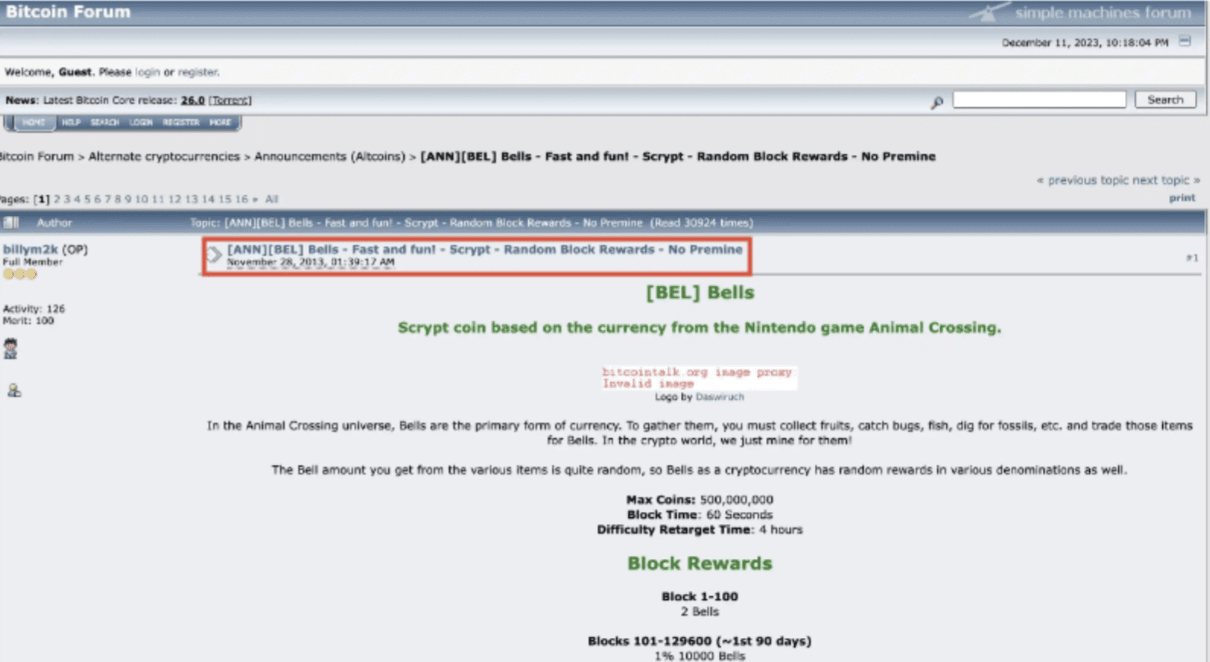
Whether Bells can gain more attention in the cryptocurrency space and whether it will evolve into an interesting and useful project are aspects that need to be watched. The future outlook will depend on community participation, developer contributions, and the sustainability of the project.
3.2 DFINITY Alternative DePin+DeServer
Dominic, the founder of ICP, revealed in an in-depth interview that the price damage to ICP (which once had a market value of more than 230 billion US dollars) was largely due to SBF. The same venture capital companies will make a lot of money for the founders of Aptos and Sui, and these public chains cannot be compared with ICP. ICP has a large R&D team with a large number of the smartest technical talents who have been working in the blockchain industry for many years. For example, a social network running on Sui or Aptos? That is completely impossible, but ICP can do it.
At the same time, ICP is expected to be at the core of the AI revolution, driving innovation in an open environment by combining AI models and data on the Internet Computer. ICP is expected to become a marketplace for AI models, enabling people to quickly develop and apply various AI computing units. Users will be able to choose from hundreds of different AI models and upload data for analysis. This is expected to prompt people to make more extensive use of AI technology, thereby promoting the development of the industry. On the Internet Computer, ICP is committed to ensuring the confidentiality of data and the privacy of AI models to prevent leakage.

ICP uses decentralized blockchain technology, so that there is no single control point for the entire network. This architecture helps to improve the robustness and security of the system. ICP is designed to support a decentralized application ecosystem, allowing users to build and run applications on a decentralized platform without relying on traditional centralized servers.
ICP is not a blockchain project in the traditional sense, but a new computing platform called Internet Computer. It introduces some innovative concepts, including container theory, smart contracts, on-chain computing, etc. Therefore, ICP is more accurately a new type of decentralized computing platform, not just a blockchain project, so it is also DePin+DeServe to some extent.
3.3 Inscriptions and Traditional Miners
Mentioning miners in the DePin track is somewhat vulgar. But it is undeniable that miners and memory pools are an important part of DePin. This does not prevent this vulgar track from being so attractive and rewarding!
Mining has recently become a hot topic in the infrastructure track. The phenomenon of getting rich by inscriptions has attracted the attention of a large number of miners. The gas fees burned by various inscriptions have enabled miners to obtain considerable profits. This phenomenon has also attracted attention and discussion on mining behavior in the industry.

The mining model has a strong sense of participation and clear economic incentives. The development of DEPIN does not only rely on investors in digital assets, but also requires extensive community participation. By actively participating in the construction of the DEPIN network, miners can not only obtain economic rewards, but also become one of the builders of this ecosystem. This community co-construction model helps to form a more decentralized, democratic and resilient network structure.
3.4 What to invest in DePin in the future
The rise of DEPIN represents the extension of decentralized technology at the physical infrastructure level, laying a more robust foundation for the future digital society. At the same time, many exchanges went online during the bull market to help liquidity; infrastructure tokens entering exchanges brought increased liquidity and attention. You can try to invest in tokens in the DePin direction of the application layer such as AI/GameFi/SocialFi. However, some tokens have the risk of price bubbles, so investment should be cautious.
To judge a specific DePin project, it is necessary to study and judge, including the project's technical maturity, business logic, overall development plan, project shareholders, current market value and future space, project community, ecological construction and other factors. However, investment still needs to carefully judge the technical risks of the project to avoid blindly following the trend. Overall, the infrastructure track caters to the needs of distributed large storage and privacy computing in the 5G and Web3 era, and it is worthy of attention and continued investment.
Summarize
The decentralized infrastructure track is not smooth sailing. Controversial projects such as the FIL project and AR/STORJ have caused different voices in the market. Some people believe that its technological innovation can promote the development of the industry, while others have questioned its feasibility. This controversial project has also become one of the hot topics discussed in the infrastructure track. The BiB Exchange team believes that DePIN provides decentralized storage, meets the needs of massive data, user data autonomous control, encrypted distributed storage, supports the speed of the bull market development in the past two to three years, and meets the application development and continuous development of various Web3 projects.
We believe that DePin will show an increasing trend in future development. With the continuous innovation of blockchain technology, DePin plays a key role in protecting privacy, improving security, and reducing centralization risks. In the foreseeable future, DePin will penetrate various industries more widely, promote digital innovation, and promote a more open, transparent and secure environment.