


Last weekend, PEPE, which had been silent for a long time, suddenly made big news.
Three former team members were accused of stealing 16 trillion PEPE tokens and selling them on various cryptocurrency exchanges, and then deleted their social media accounts. The incident caused the token price to fall by nearly 20%, causing panic among investors.
A developer of the project revealed that the tokens in the multi-signature wallet were stolen, and three former team members sneaked back and modified the multi-signature mechanism to steal the tokens in the wallet.
At present, it seems that most of the tokens stolen from the multi-signature were quickly sold on OKX and Binance. Officials said that the remaining 10 trillion tokens in the multi-signature will be transferred from the old multi-signature to a new wallet, where the developers said they will be safely stored.
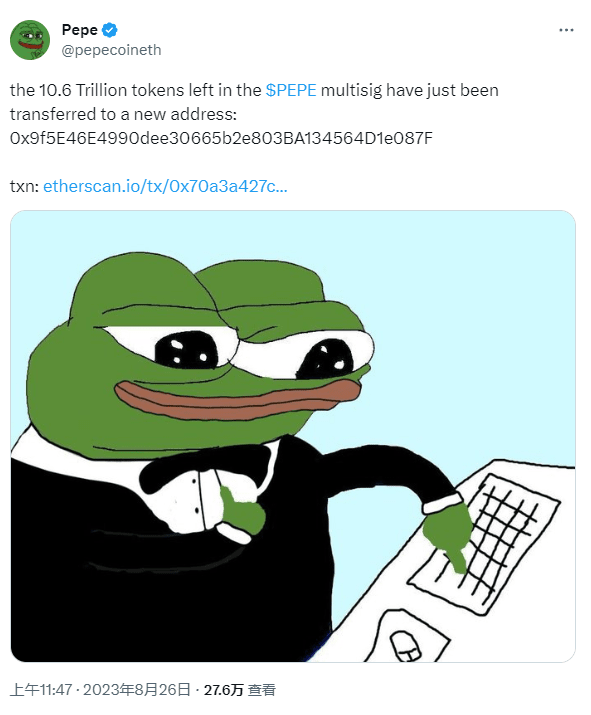
On-chain analysts tracked the funds sent to centralized exchanges and found that $6.5 million was sent to Binance, $8.2 million was sent to OKX, $434,000 was sent to Bybit, and $389,000 was sent to another address. The tokens transferred to the exchange accounted for about 3.8% of the circulating supply of PEPE.
Not everyone believes the story of PEPE developers accusing former team members of masterminding the theft, with some suggesting that the team developers may have used multiple accounts to carry out the theft.
On the 25th of this month, the PEPE multi-signature wallet suddenly changed the threshold from 5/8 to only 2/8, which means that only two private key holders need to sign the transaction to transfer team assets. The official announcement explained that the change in the threshold was made by the former members who stole the coins.
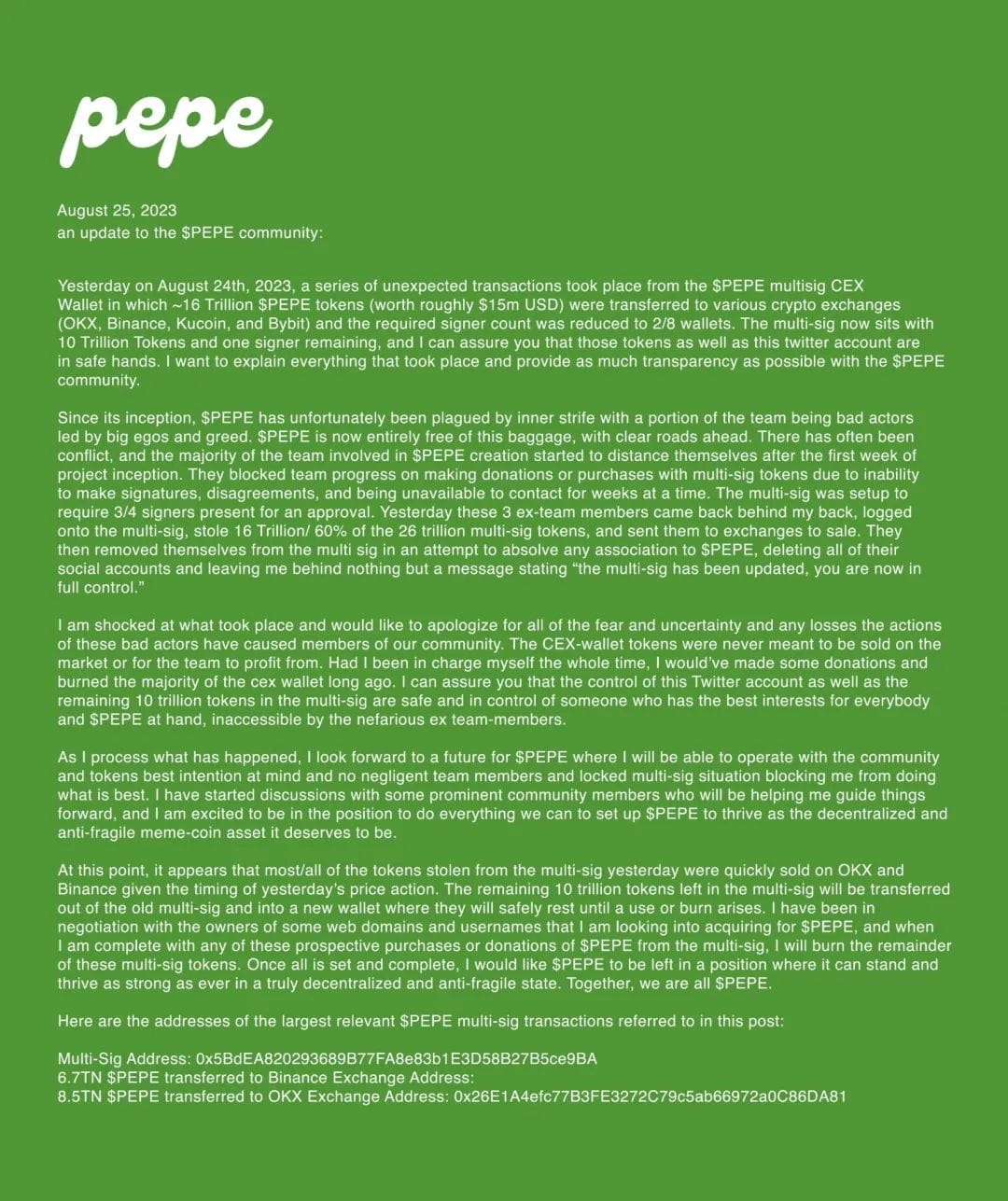
According to the official announcement, PEPE has been plagued by internal disputes since its inception, and some people in the team have become bad actors due to arrogance and greed. Previously, due to the inability to sign transactions, differences of opinion, and inability to contact them for weeks, these people hindered the team's progress in using multi-signature wallets to make donations or purchase tokens. The multi-signature is set to require 3/4 signatories to be present for approval. Three former team members secretly returned on August 25, modified the multi-signature threshold, stole 60% of the tokens in the multi-signature wallet, that is, the 16 trillion PEPE, and sent them to the trading platform for sale.
The announcement stated that the remaining 10 trillion tokens in the multi-signature wallet are safe and can no longer be accessed by former team members. The PEPE team said that the prospects are bright after eliminating internal conflicts, and it is currently planning to use the remaining tokens to purchase the PEPE domain name, and the remaining tokens will be destroyed in the future.
Although the official social account explained the reasons behind the token sell-off and temporarily stabilized the emotions of some users, users are still skeptical of the official explanation, as can be seen from the fact that some investors continue to sell their PEPE assets.
01PEPE investors panic
According to CoinMarketCap, PEPE’s price has continued to decline over the past 24 hours. As of writing, it is trading at $0.0000008377 with a market cap of $328 million.
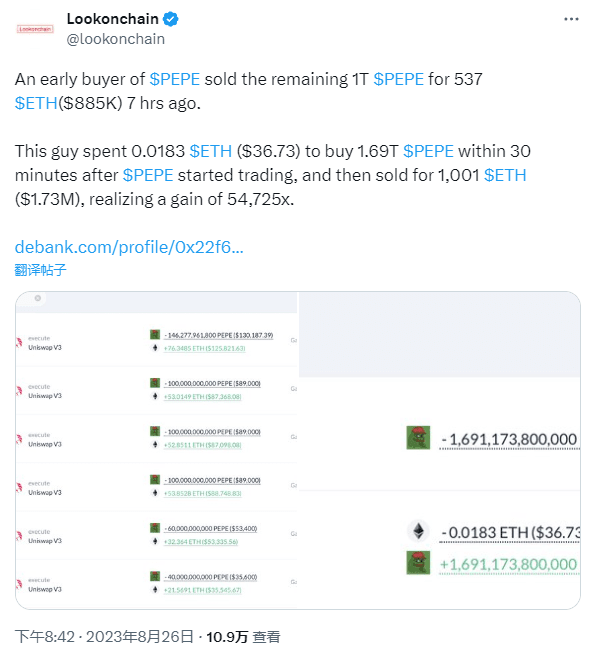
In fact, some investors are still selling their tokens. A recent tweet from Lookonchain showed that an early buyer of PEPE sold the remaining 1 trillion PEPE for 537 Ethereum, worth $885,000.
02 The team dumped the market to shake the consensus
The blatant team dumping of the stock angered the community and shook investors' consensus confidence in PEPE.
Speaking of meme tokens, the only one that can beat Dogecoin is probably PEPE. The original source of PEPE, Pepe the Frog, can be traced back to 2005. It was designed by cartoonist Mat Furie and then became popular in the graphic forum 4chan in 2008.
For the crypto field, Pepe the Frog is an IP that everyone is familiar with. Telegram and Discord communities are full of Pepe the Frog's emoticons, and many teams directly choose the image of Pepe the Frog as their mascot. To exaggerate a bit, it is not an exaggeration to say that the crypto field cannot be without Pepe the Frog.
The PEPE token, which was born based on the Pepe Frog IP, claimed at its first launch that the project had three things: no roadmap, no formal team, no high transaction fees, and even directly put more than 90% of the tokens into the Uniswap liquidity pool.
PEPE's founders designed it as a digital currency to reward content creators and community members. Its goal is to provide a fast, low-cost transaction method and encourage users to use PEPE to communicate and interact in social media, games and other online applications.
However, it is important to note that the creators of PEPE do not own the copyright to Pepe the Frog, and the image of Pepe the Frog has been abused by some extremist groups. Like other meme tokens, PEPE has been criticized for its apparent meaninglessness. It has no potential use cases or business propositions, whether as a payment system, development platform, or otherwise. In fact, the creators of PEPE explain the issue directly on their website, proudly claiming that PEPE is "completely useless and is for entertainment purposes only," has "no value support mechanism," and "will not be responsible for your trading losses."
However, when PEPE was launched, there were not many hot spots in the market, so many people's attention was attracted by it. There were also many stories of people becoming millionaires by buying meme tokens early on, which made the market atmosphere at the time even more FOMO.
The team members' sale of coins also angered some insiders.
In anger, Pauly, the founder of Not Larva Labs, disclosed the information of PEPE's founder on Twitter.
Zachary Testa, born in Phoenix, Arizona in 1997, graduated from Arizona State University in 2018 with a degree in marketing. Pauly said that he used the income from the issuance of PEPE to buy a purple Lamborghini worth $865,000, and his team did not pay any copyright fees to Matt Furie, the original creator of Pepe Frog. Pauly said that he helped the PEPE team connect with the Binance coin listing team and the Sushi team.
Pauly called on everyone to report to the SEC and left a friendly reminder: when the amount of sanctions exceeds $1 million, the whistleblower reward can reach 10% to 30% of the funds collected.
The trust crisis regarding PEPE will probably continue to ferment for some time, which is the most fatal to the consensus-based meme project.
03 Conclusion
There have been many rumors about PEPE's wealth-making myth, which has made people anxious about other people's stories of getting rich quickly. People's fanatical pursuit of meme-based wealth has never stopped.
However, the incident of PEPE team members stealing coins has also caused people to question grassroots meme projects. The unprofessionalism of team members and the looseness of management organizations also make it impossible for most meme projects to operate in the long term.
After this incident, investors should be more vigilant and cautious in participating in it. After all, in the current encryption field, it is no longer a secret that if you don’t lose, you will make money.